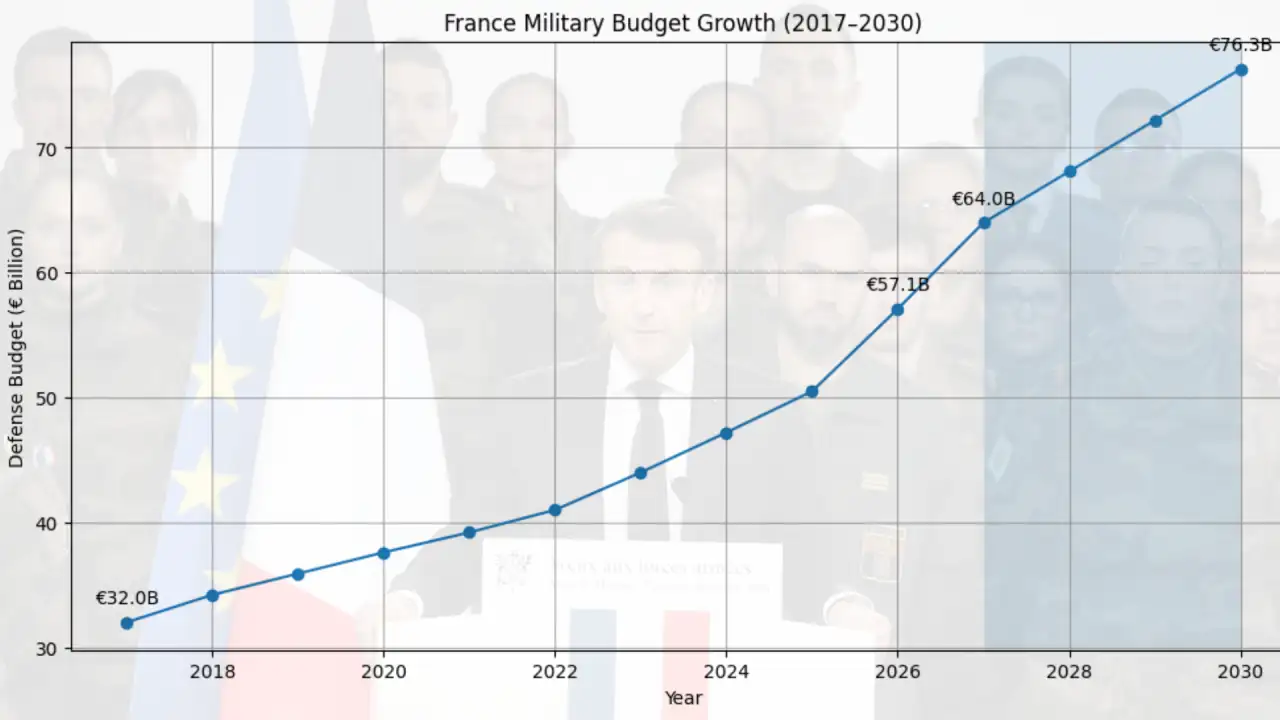
In a move that underscores the shifting security landscape of the continent, France is significantly ramping up its military spending. The government has announced an additional €36 billion for defense through 2030, bringing the total allocation for the period to approximately €449 billion. By 2030, France’s annual defense budget is projected to reach €76.3 billion, nearly double the 2017 level of around €32 billion, equivalent to about 2.5% of GDP.
This expansion focuses heavily on rebuilding depleted stockpiles and enhancing capabilities for modern, high-intensity warfare. Key priorities include a massive increase in munitions, with drone inventories set to surge by up to 400%, Scalp cruise missile stocks by 85%, torpedoes by 230%, and surface-to-air missiles by 30%. Additional investments target air defense systems and an expansion of France’s nuclear deterrent.
France is far from alone. Across Europe, nations are accelerating defense investments in response to heightened geopolitical tensions, particularly Russia’s ongoing war in Ukraine and broader concerns about hybrid and conventional threats. EU member states’ combined defense expenditure has risen sharply: from around €218 billion in 2021 to €343 billion in 2024, with projections reaching €381 billion in 2025 (about 2.1% of GDP).
This represents a roughly 63% increase since the early 2020s. Several countries are pushing well beyond NATO’s former 2% GDP benchmark:
▪️Germany, Europe’s largest economy, has seen dramatic growth, with spending reaching around €95 billion in 2025 (roughly 2.1-2.3% of GDP) and plans for further increases toward 3%+ levels.
▪️Poland leads in relative terms, spending over 4% of GDP.
▪️Nordic and Baltic states, including Sweden, Finland, Denmark, Lithuania, Latvia, and Estonia, have implemented major uplifts in budgets, focusing on air defense, long-range weapons, and total defense concepts.
▪️Southern and Western European nations like Spain, the Netherlands, and Italy are also scaling up, with many crossing or approaching the 2% threshold.
European NATO members collectively increased spending by nearly 20% in real terms in 2025, contributing to a broader continental push toward self-reliance.
Why the Rush? Munitions, Deterrence, and Readiness
The emphasis on stockpiles reflects lessons from Ukraine, where artillery shells, drones, and missiles are consumed at rates far exceeding peacetime production. Russia’s ability to sustain high-volume fire has exposed vulnerabilities in Western supply chains. European countries are now prioritizing “mass” in addition to high-tech capabilities—building reserves of ammunition, expanding drone fleets, and strengthening air and missile defense.
France’s plan explicitly aims to prepare for potential “major engagement” scenarios within years, not decades. Similar thinking drives initiatives across the EU, including efforts to boost domestic production of 155mm shells, missiles, and anti-drone systems. The continent is addressing critical gaps in industrial capacity that were neglected during decades of post-Cold War “peace dividends.”
Nuclear dimensions add another layer. France is modernizing and expanding its nuclear arsenal as part of its strategic deterrent, while the UK maintains its own. Discussions about broader European nuclear sharing or enhanced conventional-nuclear integration have gained traction amid uncertainty over long-term transatlantic commitments.
Analysts describe this as Europe’s most significant rearmament since the Cold War. Initiatives like the EU’s ReArm Europe plan, European Defence Industrial Strategy, and joint procurement mechanisms signal a strategic pivot: reducing over-reliance on the United States while building credible collective defense.
Critics argue that fragmented national efforts still hinder full efficiency, with calls for deeper integration in procurement, production, and command structures. Proponents see it as essential insurance against an era of great-power competition, where deterrence must be visible and robust.
As annual spending climbs and factories ramp up output, Europe is visibly shifting from a post-war mindset of low-intensity operations to one prepared for peer-level conflict. France’s latest budget surge is not an outlier but a prominent example of a continent-wide awakening. Whether this buildup prevents war or prepares for one remains the defining question of European security in the coming decade.