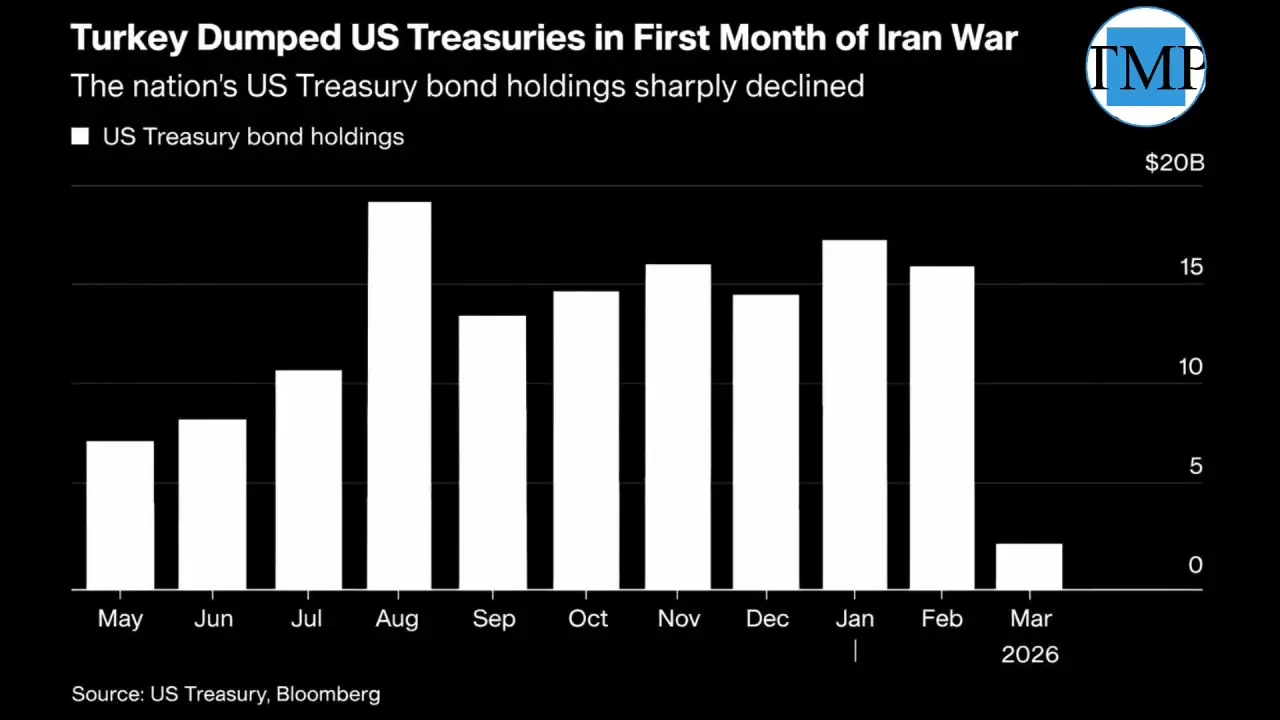
In a striking move reflecting heightened economic pressures, Türkiye dramatically reduced its holdings of US Treasuries in March 2026, according to US Treasury data reported by Bloomberg and other outlets. The country’s holdings plunged from approximately $16 billion in February to just $1.8 billion by the end of March, representing a net sale of roughly $14 billion.
This sharp drawdown involved significant sales of both long-term and short-term securities. Long-term holdings fell to about $839 million after $10.3 billion in net sales, while short-term holdings dropped to $945 million.
The sales form part of Ankara’s broader strategy to bolster foreign exchange liquidity and support the Turkish lira (TRY) amid severe market volatility triggered by the ongoing Iran war, which escalated in late February 2026. As a major energy importer, Türkiye has faced rising oil and gas prices, contributing to capital outflows and currency pressure.
The Central Bank of the Republic of Türkiye (CBRT) has tapped into foreign exchange and gold reserves to intervene in currency markets. Reports indicate the bank sold around $16–22 billion in foreign government securities, including US Treasuries, in recent weeks, while considering further use of its substantial gold holdings, valued at roughly $135 billion earlier in the year, to defend the lira.
Despite these interventions, the lira remains under significant pressure. Inflation has accelerated, reaching 30.87% in March and climbing further to 32.37% in April 2026, driven largely by higher energy costs and broader war-related disruptions. Turkish government bond yields have surged to record levels, reflecting investor concerns over inflation, currency stability, and fiscal strains.
The moves mark a reversal from earlier trends. Türkiye had been rebuilding its US Treasury positions in late 2025 and early 2026, with holdings rising to around $17 billion in January before the sharp sell-off.
Türkiye’s actions are not isolated. Foreign official holdings of US Treasuries, particularly at the New York Fed, have declined notably since late February, with several central banks liquidating assets to support their domestic economies and currencies amid the geopolitical shock from the Iran conflict. Oil price spikes and supply concerns have exacerbated inflationary pressures worldwide, prompting defensive reserve management by emerging markets.
Analysts note that while Türkiye’s $14 billion sale is modest relative to the overall US Treasury market (over $9 trillion in foreign holdings), it underscores the acute challenges facing import-dependent economies in the current environment.
The CBRT’s aggressive reserve deployment has provided some short-term stability, but sustained pressure on the lira, combined with elevated inflation and borrowing costs, poses risks to Türkiye’s economic recovery. Markets will closely watch upcoming inflation data, reserve levels, and any signs of de-escalation in the Middle East for clues on the trajectory ahead.
As geopolitical tensions persist, Türkiye’s balancing act between reserve management, currency defense, and inflation control will remain a critical test for policymakers in the months to come.