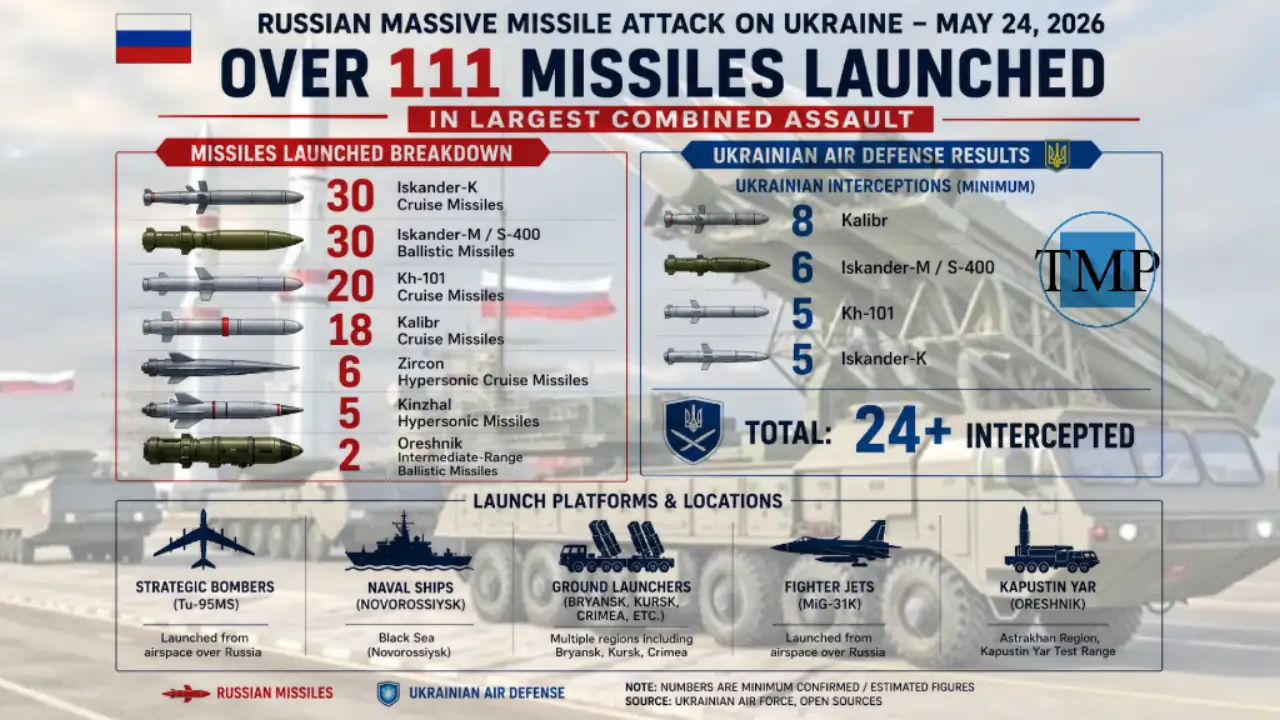
In the early hours of May 24, 2026, Russia conducted one of its largest combined missile attacks of the ongoing war, launching approximately 111 missiles of various types against Ukrainian territory. The assault, which also included a significant number of drones, focused heavily on the capital Kyiv and surrounding regions.
Scale and Composition of the Attack
According to detailed breakdowns, Russian forces employed a multi-domain launch strategy involving strategic bombers, ground-based systems, naval vessels, and fighter aircraft:
▪️20 Kh-101 cruise missiles launched from 4 Tu-95MS strategic bombers over western Kostroma Oblast.
▪️30 Iskander-K cruise missiles from installations in Bryansk and Kursk Oblasts.
▪️18 Kalibr cruise missiles from surface ships at Novorossiysk Naval Base.
▪️30 Iskander-M/S-400 ballistic missiles from positions in Bryansk, Kursk, Voronezh, and Crimea.
▪️6 Zircon hypersonic cruise missiles from ground installations in western Crimea.
▪️5 Kinzhal hypersonic aeroballistic missiles from MiG-31K fighters over Tambov Oblast.
▪️2 Oreshnik intermediate-range ballistic missiles from Kapustin Yar Testing Ground in Astrakhan Oblast.
This diverse mix of weapons, including hypersonic systems like Zircon, Kinzhal, and the newer Oreshnik, aimed to overwhelm Ukrainian air defenses through saturation tactics.
Ukrainian Air Defense Response
Ukrainian forces reported intercepting a significant portion of the incoming threats. As of the latest updates, confirmed interceptions included:
▪️At least 8 Kalibr cruise missiles
▪️6 Iskander-M/S-400 ballistic missiles
▪️5 Kh-101 cruise missiles
▪️5 Iskander-K cruise missiles
This brings the minimum number of intercepted missiles to 24. Ukrainian air defenses, supported by mobile groups and allied systems, engaged multiple waves throughout the night and into the morning. Full tallies, including drone interceptions, are still being compiled.
Impacts and Casualties
The strikes caused damage across Kyiv and other regions, with reports of civilian casualties and infrastructure hits. President Volodymyr Zelenskyy and local officials confirmed deaths and injuries in the capital area, describing it as one of the heavier bombardments in recent months. The use of the Oreshnik missile near Bila Tserkva (southwest of Kyiv) was particularly noted for its distinctive submunition effects.
This attack follows a pattern of intensified Russian long-range strikes in 2026, often involving hundreds of drones alongside missiles in efforts to exhaust Ukrainian interceptors.
Military analysts view such operations as attempts to degrade Ukraine’s energy infrastructure, air defense capabilities, and civilian morale ahead of further ground operations. Russia has increasingly relied on massed salvos combining legacy cruise missiles with newer hypersonic and ballistic systems.
Ukraine has vowed a strong response and called for continued international support to bolster its air defenses. The international community continues to monitor the situation closely amid ongoing diplomatic efforts.
This latest escalation underscores the persistent intensity of the conflict, now well into its fourth year, with both sides leveraging advanced weaponry in a high-stakes aerial campaign. Updates will follow as more details emerge from Ukrainian authorities and independent verification.