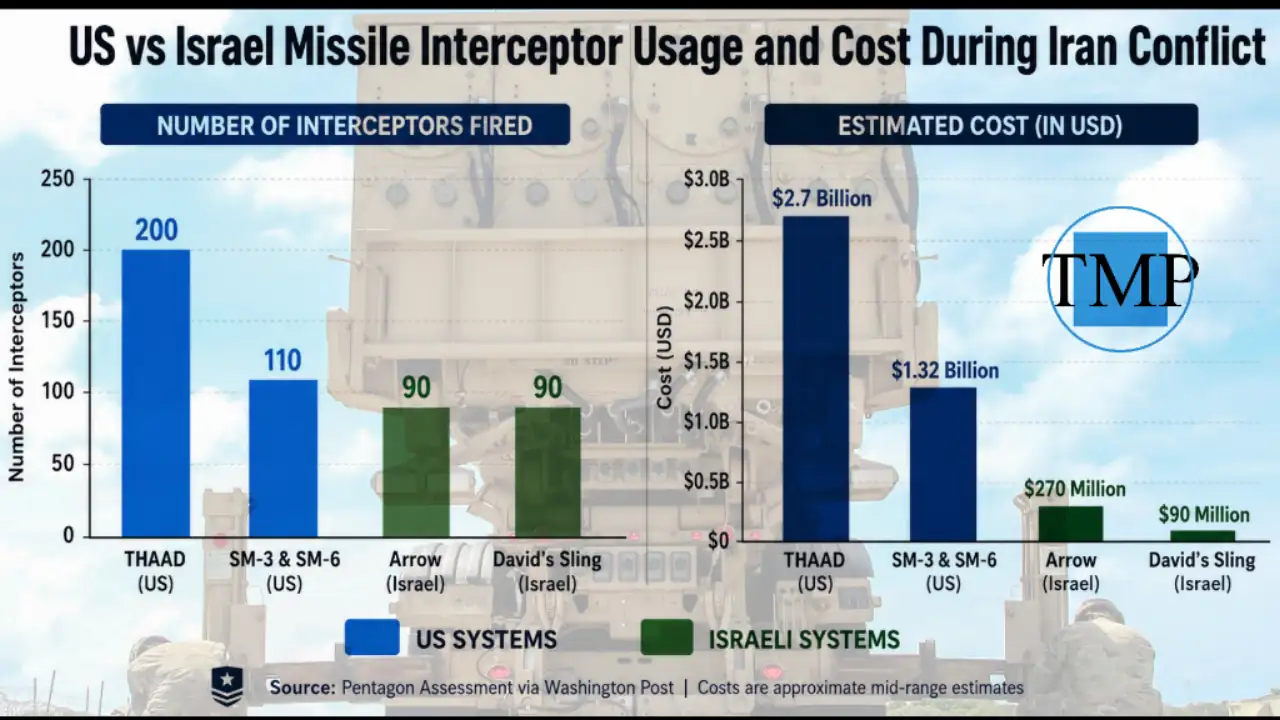
In a significant revelation about allied defense dynamics, a Pentagon assessment indicates that the United States shouldered much of the missile defense burden for Israel during its recent war with Iran. According to officials speaking to The Washington Post, US forces fired more than 200 Terminal High Altitude Area Defense (THAAD) interceptors, nearly half of the Pentagon’s total inventory, along with over 100 SM-3 and SM-6 ship-launched interceptors.
By comparison, Israeli forces used fewer defensive missiles: fewer than 100 Arrow interceptors and approximately 90 David’s Sling interceptors. One US government official noted that this underscores a key reality: “Israel cannot fight alone,” though much of this behind-the-scenes support remains invisible to the public.
The disparity has raised concerns about US munitions stockpiles and readiness for potential conflicts in other theaters, particularly in the Asia-Pacific region. Production lines for these advanced systems cannot quickly replenish depleted stocks, leaving the US with significantly reduced reserves of high-end interceptors.
The Scale of US Involvement
US naval assets in the eastern Mediterranean and THAAD batteries deployed in the region played a critical role in intercepting Iranian ballistic missiles. The assessment notes that the US engaged roughly twice as many threats as Israeli systems and fired about 120 more interceptors overall.
This support came amid intense Iranian barrages, with reports indicating Iran launched hundreds of ballistic missiles toward Israel in coordinated attacks. The layered defense, combining US THAAD and Aegis systems with Israeli Arrow, David’s Sling, and other assets, proved largely effective, but at a substantial cost to American inventories.
Cost Calculation of Interceptors Used (by TMP Staff)
Using the latest available unit cost estimates, here is a breakdown of the approximate financial expenditure on the interceptors mentioned. Costs are estimates and can vary based on specific variants, contracts, and production batches. We’ve used mid-range figures for calculations where ranges apply.
US Interceptors:
▪️THAAD: Over 200 fired. Unit cost: $12–15 million (commonly cited ~$12.7 million).
▪️Midpoint estimate: $13.5 million each.
▪️Total for 200 THAAD: 200 × $13.5M =$2.7 billion.
(Range: $2.4B at $12M to $3.0B at $15M)
▪️SM-3 and SM-6 (combined over 100): Breakdown not specified, so a conservative mixed estimate is used.
▪️SM-3 Block IB: ~$12–15M (mid ~$13.5M)
▪️SM-3 Block IIA: ~$28–29.5M (mid ~$29M)
▪️SM-6 Block I/IA: ~$4.25M
▪️SM-6 Block IB: ~$6–8.5M (mid ~$7.25M)
Assuming a realistic operational mix (e.g., heavier on SM-6 for some roles and SM-3 for exo-atmospheric intercepts), an average of $12 million per missile across the 100+ is a reasonable blended estimate.
▪️Total for 110 SM-3/SM-6 ( conservative over 100 ): 110 × $12M = $1.32 billion.
( This could range from ~$800M if mostly cheaper SM-6 to over $2B if many advanced SM-3 IIA. )
▪️Estimated Total US Interceptor Cost:
Approximately $4.02 billion (THAAD + SM-3/SM-6). This does not include operational costs, deployment, or replenishment premiums.
Israeli Interceptors (for context):
▪️Arrow (fewer than 100, say ~90): Unit cost estimates typically $2–3.5 million. Mid ~$3M.
Total: ~$270 million.
▪️David’s Sling (~90): Unit cost ~$1 million (Stunner interceptor).
Total: ~$90 million.
▪️Israeli Total (est.): Under $400 million.
The US expenditure significantly outpaced Israel’s in raw interceptor costs, highlighting the depth of American logistical and technological support.
Pentagon officials have expressed worry about the depletion. With production rates lagging (e.g., limited annual THAAD output), replenishing these stocks could take years and cost billions more. Allies in Asia are reportedly concerned about US capacity to deter threats from China or North Korea while supporting Israel.
A US official emphasized the shared nature of the defense network, but the numbers tell a story of asymmetric burden-sharing in high-intensity missile exchanges. This conflict has sparked broader debates on missile defense economics: expensive Western interceptors versus cheaper, mass-produced Iranian ballistic missiles.
As tensions in the Middle East continue to evolve, the long-term implications for US defense posture and alliance commitments remain under scrutiny. Replenishment efforts and potential increases in production will likely feature prominently in future Pentagon budget requests.