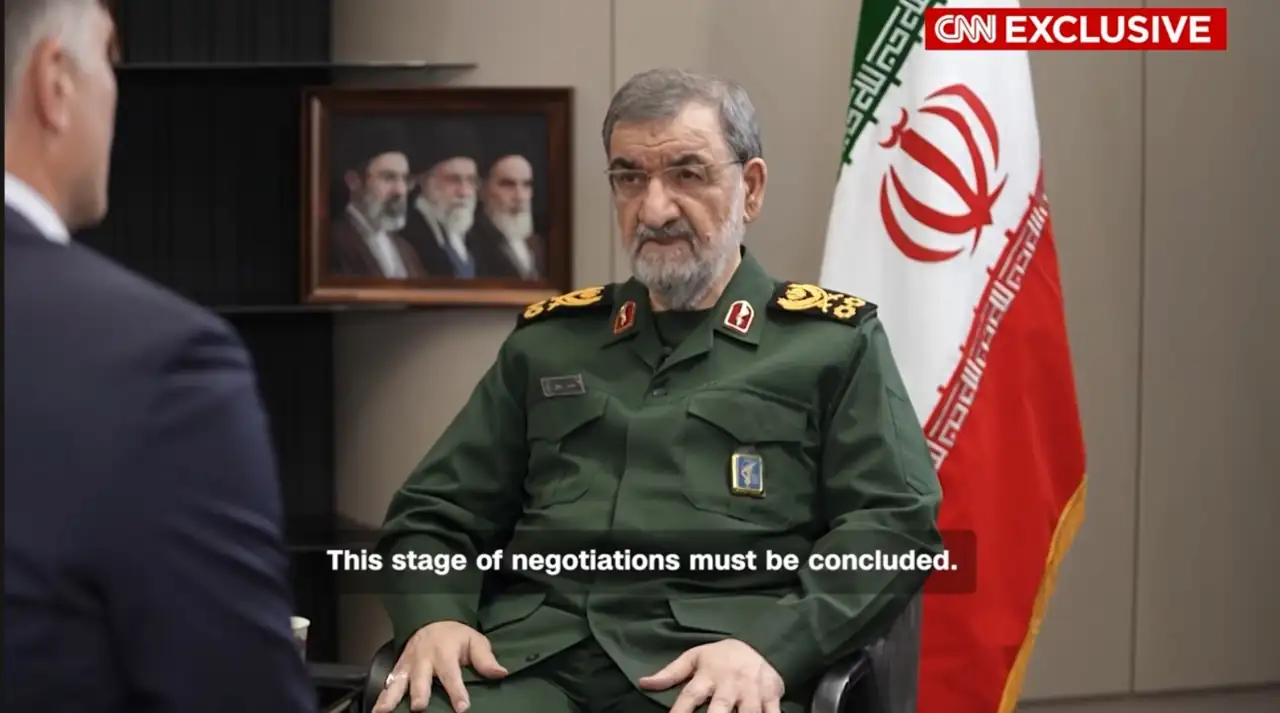
In a rare exclusive interview with CNN’s senior international correspondent Frederik Pleitgen, Mohsen Rezaei, senior military adviser to Iran’s Supreme Leader, laid out Tehran’s firm position amid stalled U.S.-Iran negotiations. Rezaei made clear that the release of approximately $24 billion in frozen Iranian assets is a non-negotiable “test of trust” for any progress, while issuing stark warnings of escalation if the naval blockade continues.
The interview highlights Iran’s dual approach: a demand for sanctions relief paired with readiness to expand the conflict if diplomacy fails. Rezaei explicitly threatened to extend operations to major maritime chokepoints, including the Strait of Hormuz, Bab al-Mandab Strait, the Red Sea, the Indian Ocean, and the Mediterranean Sea.
Full Key Excerpts from the CNN Interview:
Frederik Pleitgen: You are the military adviser of the supreme leader. How is the supreme leader doing? Is he fully in control of everything? And President Trump said that he would be honored to meet the supreme leader.
Mohsen Rezaei: This will not happen. Right now, we are in the first stage of negotiations, and Mr. Trump has brought the negotiations to a standstill. This will not happen.
Frederik Pleitgen: Are the negotiations right now blocked, or do you think that a memorandum of understanding can be reached quickly?
Mohsen Rezaei: In my opinion, the negotiations are at a deadlock, and Trump must break this deadlock. … Iran has openly stated that our assets have been frozen, and you must release them. The Americans are not telling the truth in this regard.
Frederik Pleitgen: So, the frozen assets are the big problem right now?
Mohsen Rezaei: This is a sign of trust building. If Trump takes the negotiations seriously, $24 billion is not much to America. If he wants to reach an agreement with Iran, this $24 billion is a test of trust that Iran wants to have with Trump. This is a test that America must pass, and the path will be opened. This is our own money, not America’s money.
Frederik Pleitgen: Wouldn’t a war be catastrophic for Iran as well though? If it was a big bombing campaign?
Mohsen Rezaei: If the war continues and the naval blockade is not lifted, we will drag the war to the Indian Ocean, the Bab al-Mandab Strait, the Red Sea, and the Mediterranean, and we will give another dimension to the war by attacking these other American bases that we have been attacking so far. America will definitely suffer much more losses. America’s losses will be very heavy.
Frederik Pleitgen: Final question, what’s your message to Donald Trump?
Mohsen Rezaei: Mr. Trump must make decisions independently of Israel. He must give what is the rights of the Iranian people and stop the blockade, release our frozen assets, and this can be a new horizon for the future of Iran and America. Therefore, Trump must put aside his personal interests and think about the interests of the American people. If Trump has the courage, many issues will be resolved in the future.
This exchange underscores Iran’s strategy: it is prioritizing the unfreezing of its assets and lifting of sanctions as a prerequisite for de-escalation, while simultaneously preparing to threaten global shipping lanes, most notably the Strait of Hormuz (a critical oil transit route) and Bab al-Mandab, if the current naval blockade persists. Rezaei framed continued hostilities as leading to far greater costs for the United States.
The interview, conducted in Tehran, reflects Iran’s postwar positioning following recent regional conflicts. No full public verbatim transcript of the entire unedited conversation has been released, but the aired and published segments capture the core substance.
Rezaei’s remarks portray the $24 billion as a low-cost goodwill gesture for Washington that could open broader talks, while the threats to expand the theater of war signal Iran’s willingness to disrupt international maritime traffic if demands are unmet. This stance keeps pressure on the Trump administration to either concede on sanctions relief or risk a wider confrontation.