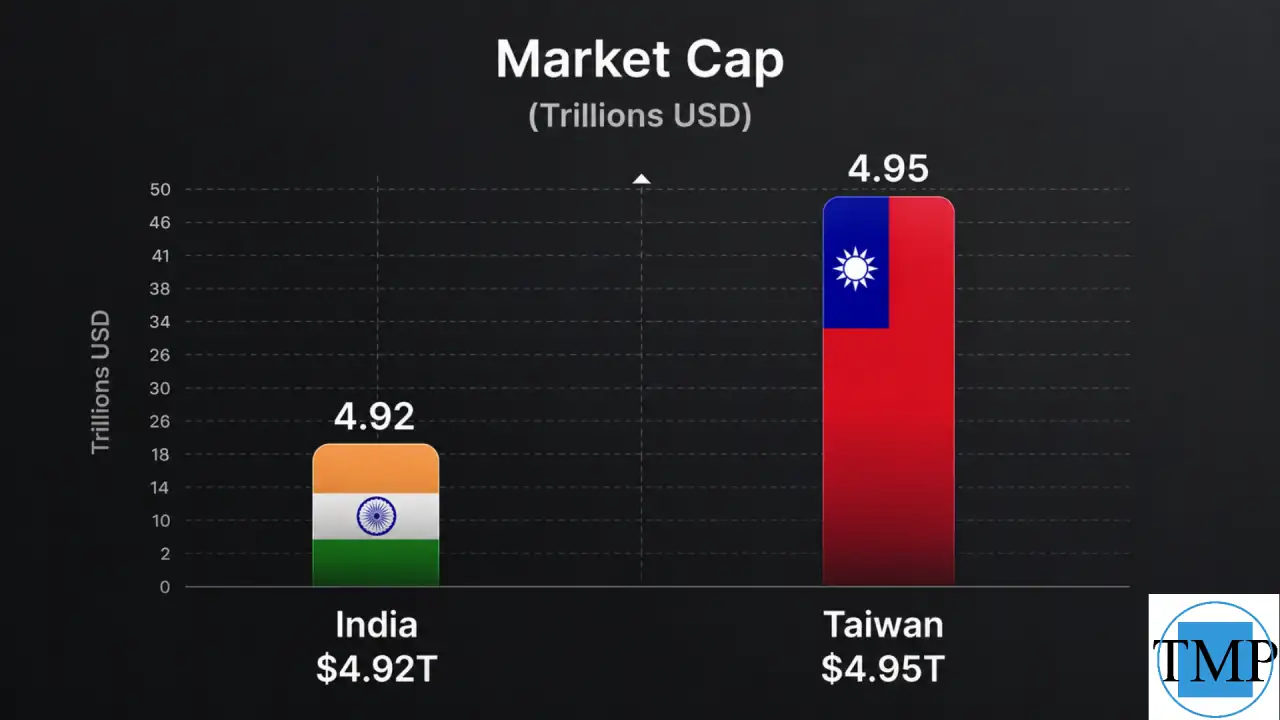
In a striking illustration of how concentrated technological prowess can outweigh sheer scale, Taiwan has officially edged past India to become the world’s fifth-largest stock market by total market capitalization.
As of May 25, 2026, Taiwan’s equity market reached $4.95 trillion, narrowly surpassing India’s $4.92 trillion.
The milestone is particularly noteworthy given the vast disparity in size. Taiwan’s population stands at approximately 23.9 million people, smaller than that of Delhi, India’s national capital, which is home to over 26 million residents.
While India boasts the world’s most populous nation status with over 1.45 billion people, Taiwan has leveraged its position as a global semiconductor powerhouse to achieve this financial feat.
The story of Taiwan’s ascent is inextricably linked to the artificial intelligence boom and Taiwan Semiconductor Manufacturing Company (TSMC).
▪️TSMC’s market capitalization has soared past $2 trillion.
▪️The chipmaker alone accounts for roughly 40-42% of the weighting in Taiwan’s main stock index.
▪️Taiwan’s overall market cap has surged dramatically in 2026, with gains exceeding 35-40% year-to-date, fueled by global demand for advanced semiconductors.
India’s stock market has itself experienced extraordinary growth over the past decade, rising from roughly $1.7 trillion in 2014 to nearly $5 trillion today.
However, this growth has been notably concentrated. A significant portion of the gains has benefited a relatively small segment of the population. Reports indicate that India’s top 1% of households hold a disproportionately large share of the country’s financial assets, estimated around 70% in some analyses highlighting that while the market has expanded impressively, the benefits have flowed primarily to the wealthiest sections rather than translating into broad-based wealth creation across the overall population.
This concentration is further reflected in high promoter ownership (often wealthy business families) in many listed companies, which hovers around 50% in the broader market. Meanwhile, retail investor participation has grown substantially in recent years, from about 1.67 crore investors in 2014 to over 11.8 crore today, but their overall influence on total market capitalization remains more limited compared to institutional and promoter holdings.
Factors Behind the Recent Overtake
Several elements appear to have contributed to Taiwan surpassing India:
▪️Foreign investor preference for AI-exposed markets.
▪️India’s relative under-exposure to the hardware side of the AI boom.
▪️A more diversified (and thus less explosive) market composition.
With this shift, Taiwan now sits in 5th place, with India close behind in 6th. Rankings at this level can fluctuate daily with currency movements, capital flows, and sector performance.
This development highlights key truths about modern capital markets:
▪️Quality and specialization in critical technologies (like semiconductors) can generate outsized value even for small populations.
▪️Wealth concentration matters: Market capitalization growth does not automatically equate to widespread prosperity. India’s impressive headline numbers mask underlying inequality in how gains are distributed.
▪️Long-term potential remains strong for India due to its demographics, domestic consumption, and digital economy, even as it navigates these disparities.
Taiwan’s rise serves as a reminder of the power of focused industrial strategy in the AI era, while India’s story underscores both the successes and limitations of its growth model. Whether India can broaden participation and reclaim the ranking will depend on policies that promote more inclusive capital market participation alongside continued economic expansion.