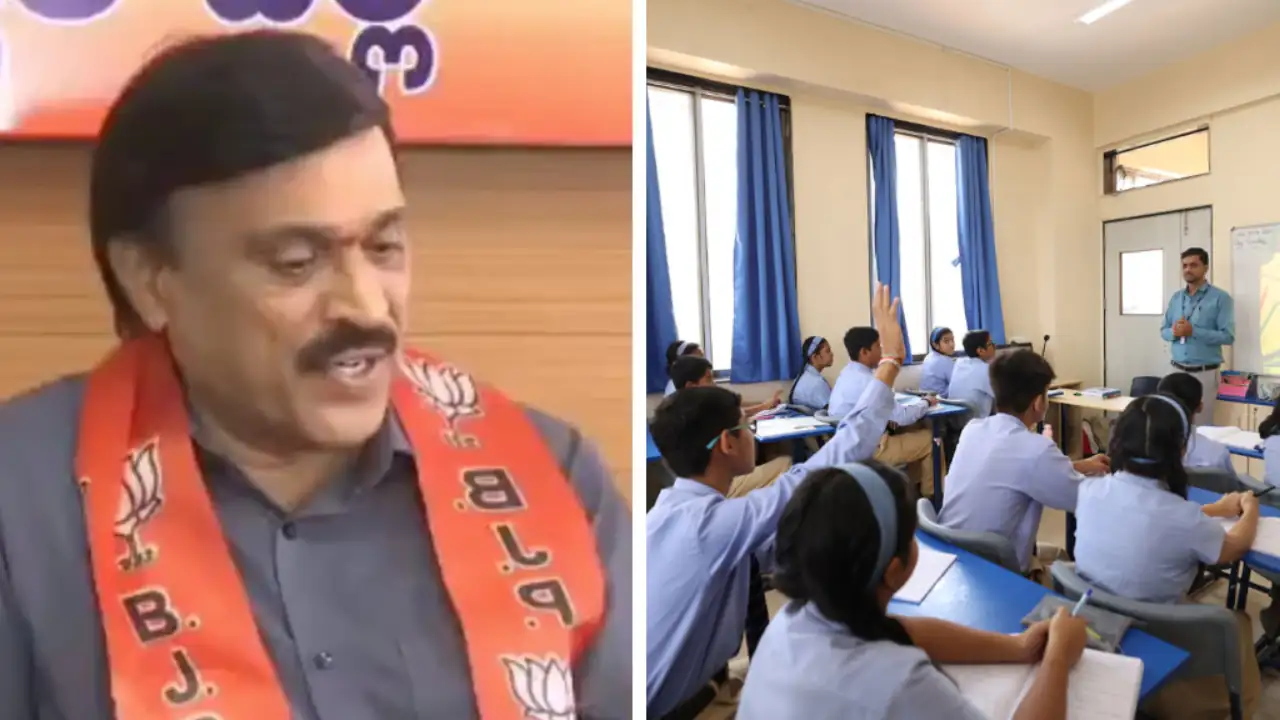
In a provocative statement, Karnataka BJP MLA G. Janardhana Reddy has supported the proposal that students in classrooms should respond with “Jai Shri Ram” during attendance calls instead of the standard “Yes Sir” or “Present.” The remark, echoing earlier comments by party colleague Basanagouda Patil Yatnal, has ignited strong criticism across political and educational circles for attempting to bring religious slogans into secular learning spaces.
G. Janardhana Reddy, the BJP MLA from Gangavathi and a prominent mining baron, carries a significant history of legal troubles. Reports highlight multiple pending and recent legal cases against him. In 2025, a CBI court convicted him in the Obulapuram Mining Company illegal iron ore mining case, sentencing him to 7 years’ imprisonment. The Telangana High Court later stayed the conviction, granted bail in June 2025, and restored his MLA status. His 2023 election affidavit declared around 20 criminal cases, including several CBI probes linked to illegal mining, many of which remain in trial stages as of 2026.
Criticism: Criminal Background, Hypocrisy, and Diversion from Education
Critics argue that it is deeply concerning when individuals with serious criminal backgrounds attempt to influence the values taught to educated youth. By promoting religious politics in schools, such leaders risk drawing impressionable students into ideological traps that prioritize division over development. This approach distracts from core issues like quality education, skill-building, job creation, and infrastructure.
A glaring hypocrisy highlighted by opponents is that many top politicians, including those advocating such policies, send their own children abroad to prestigious international institutions, paying high fees for quality, secular education, while pushing communal agendas in Indian schools and colleges. This double standard undermines public trust and exposes how religious polarization is used as a political tool within the country.
Schools, colleges, and universities are meant to be spaces for acquiring knowledge, skills, experience, and respect, not venues for communal slogans. “Jai Shri Ram” (JSR) is fundamentally a Hindu religious chant. It is not recited by students from Muslim, Sikh, Christian, or other minority communities, and imposing it can feel exclusionary or anti-religion to them. Those who label it purely as a “nationalism symbol” are often seen as blind supporters, in reality, it represents religious polarization aimed at securing political benefits rather than fostering genuine national unity.
Such tactics allow politicians to divert attention from their own governance failures. A prime example is the recurring drama of examination leaks. NEET, JEE, and board exams face paper leaks almost every year, affecting millions of students. In 2024–2026 alone, major NEET controversies led to cancellations, re-exams, and CBI investigations, eroding merit and fairness. Instead of taking accountability for creating a leak-proof, organized examination system, the focus shifts to religious issues. This pattern harms students from all communities who depend on transparent opportunities for medical, engineering, and government jobs.
The controversy underscores a deeper conflict in Indian society: the push for cultural majoritarianism in public institutions versus the need for inclusive, development-oriented education. Supporters view “Jai Shri Ram” as an assertion of cultural identity and discipline. However, Reality is that the extension of religious politics from the political arena into schools, starting first in politics and now entering classrooms, which risks alienating large sections of society and weakening the secular fabric of education.
By prioritizing such symbolic battles, leaders with pending criminal cases further polarize youth instead of addressing pressing challenges like improving learning outcomes, teacher training, equitable access, and robust anti-cheating mechanisms (digital security, biometric systems, etc.). True nationalism lies in building a strong, merit-based education system that prepares all Indian students for global competition, not in enforcing religious chants that divide rather than unite.
As the debate continues, the focus remains on whether Indian politics will move toward substantive educational reforms or remain trapped in cycles of communal distraction and hypocrisy.