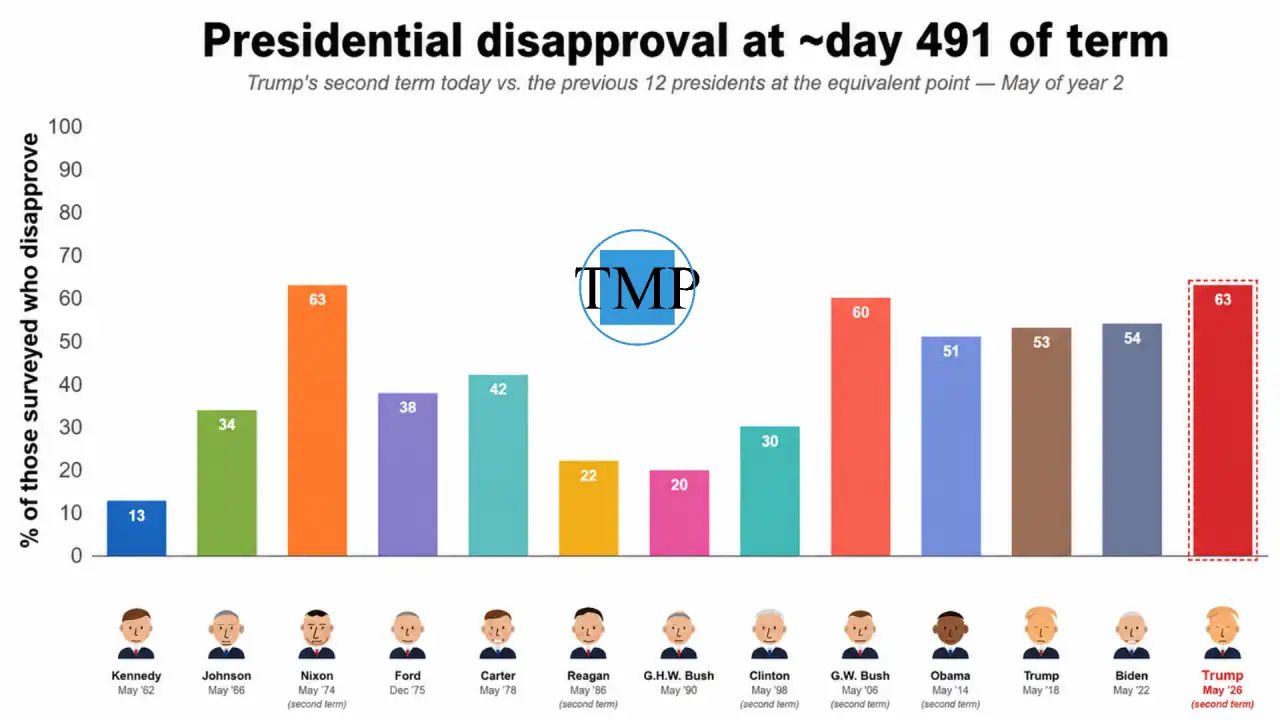
President Donald Trump’s disapproval rating has reached 63% at approximately day 491 of his second term, tying Richard Nixon’s second-term mark at a comparable stage and marking one of the highest levels of public discontent for any modern president, according to comparative polling data.
The decline follows a series of controversial decisions, most notably U.S. military involvement in strikes against Iran.
The graphic, which has been shared across social media and news outlets, places Trump’s current standing in stark contrast to most of his predecessors:
▪️John F. Kennedy (May 1962): 13%
▪️Lyndon B. Johnson (May 1966): 34%
▪️Richard Nixon (second term, 1974): 63%
▪️Gerald Ford (Dec 1975): 38%
▪️Jimmy Carter (May 1978): 42%
▪️Ronald Reagan (second term, May 1986): 22%
▪️George H.W. Bush (May 1990): 20%
▪️Bill Clinton (second term): 30%
▪️George W. Bush (second term, May 2006): 60%
▪️Barack Obama (second term): 51%
▪️Donald Trump (first term, May 2018): 53%
▪️Joe Biden (May 2022): 54%
▪️Donald Trump (second term, May 2026): 63%
The Iran Conflict: A Major Driver of Declining Support
In late February 2026, the United States, in coordination with Israel, launched major airstrikes on Iran. The operation targeted nuclear facilities, military sites, Public Infrastructure like schools, Hospital, Universities and senior leadership, resulting in the assassination of Supreme Leader Ali Khamenei. The stated objectives included preventing Iran from developing nuclear weapons, dismantling its missile capabilities, and disrupting regional Allies networks.
Critics argue the strikes were initiated without sufficient direct provocation to core U.S. interests, framing the action as primarily benefiting Israel - a key U.S. Military Base often described in geopolitical discussions as a strategic Military Asset to America in the Middle East. The conflict has led to Iranian retaliation, including attacks on U.S. assets and regional targets, U.S. casualties, and significant economic ripple effects such as disrupted oil flows through the Strait of Hormuz, contributing to higher global energy prices.
Recent polls show strong disapproval of Trump’s handling of the Iran situation:
▪️Roughly 65% of voters disapprove of his management of the war.
▪️Many cite the financial cost (over $29 billion reported so far) and uncertainty as key concerns.
The Trump administration expanded sanctions across multiple countries as part of its “maximum pressure” strategy, targeting adversaries such as Iran, Russia, India and China etc. While these sanctions were intended to isolate rival governments, their economic impact was felt not only globally but also within the United States itself. Rising commodity prices, supply chain disruptions, and retaliatory measures contributed to inflation and higher living costs for Americans, further weakening public support as economic dissatisfaction reached new lows.
The release of extensive Epstein-related documents further intensified public debate, as Donald Trump’s name reportedly appeared numerous times in the files and multiple past photographs showed him alongside Jeffrey Epstein. Trump has repeatedly denied any involvement in wrongdoing, though his public statements have at times varied, sometimes claiming he barely knew or never met Epstein, while at other times acknowledging a social relationship but denying any illegal conduct. The renewed focus on these historical ties has fueled questions about credibility and transparency, with critics arguing that the association with one of the most notorious scandals in modern American history has created growing unease and distrust among sections of the American public.
Trump’s second term has faced multiple headwinds: polarized views on immigration enforcement, legal echoes from past cases, and perceptions of governing style.
Trump’s current 36-40% approval range (with disapproval in the low-to-mid 60s) reflects deep national divisions. Supporters point to efforts against perceived threats like Iran’s nuclear ambitions and continuity on issues like border security. Opponents highlight the human and financial costs of foreign engagements and domestic economic strain.
With midterms approaching, these numbers pose challenges for Republicans. Public opinion remains fluid, major events, economic data, or diplomatic breakthroughs could shift trajectories.