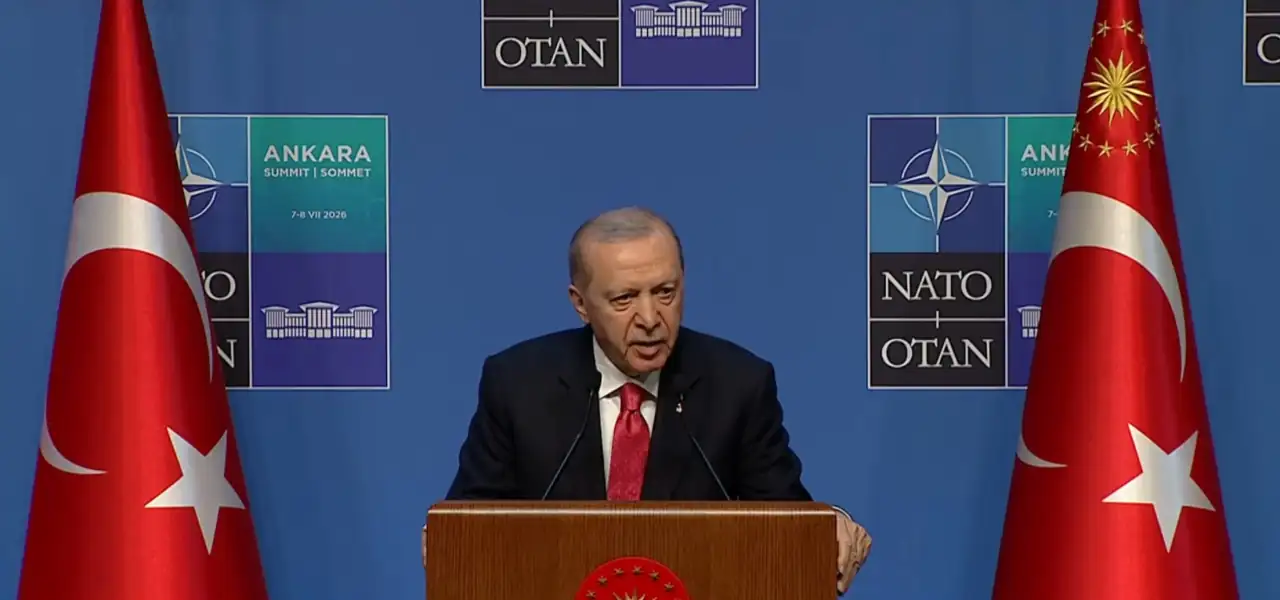
Turkish President Recep Tayyip Erdoğan addressed the media following the conclusion of the NATO Summit in Ankara, describing the gathering as a historic milestone for the Alliance. In his remarks, Erdoğan emphasized Turkey’s role as a key NATO member, highlighted the country’s advances in defense and security, reaffirmed support for fair burden-sharing among allies, and called for greater international cooperation to address ongoing conflicts. During the subsequent question-and-answer session, he discussed F-35 negotiations with the United States, relations with Greece, Turkey’s indigenous defense projects, mediation efforts in Ukraine, and broader regional security issues.
Turkish President Recep Tayyip Erdoğan delivered a wide-ranging speech following the NATO Summit in Ankara
President Recep Tayyip Erdoğan:
Ladies and gentlemen,
I greet you all with my heartfelt respect and warmest regards. Welcome to the Presidential Complex—the House of the Nation.
It is a great pleasure to be with you on the occasion of the 36th NATO Ankara Summit of Heads of State and Government. I sincerely thank each and every one of you for honoring us with your presence.
A short while ago, we successfully concluded the NATO Summit, which Turkey has hosted for the second time in 22 years and for the first time in our capital, Ankara.
At a time when Euro-Atlantic security is being seriously tested, this historic summit has shaped the direction of our common future. Here in Ankara, we laid the foundations for a stronger NATO by reinforcing our military capabilities through a fairer sharing of responsibilities, with our European allies assuming a greater role within the Alliance.
First, I would like to emphasize one important point.
As Turkey, we were unable to benefit from the post-Cold War peace dividend to the same extent as many of our European friends. Instead, we found ourselves surrounded by crises and conflicts. We had to confront terrorism and numerous security threats in our region, and there were times when we were left alone and subjected to injustice.
As a result, we often had no choice but to rely on our own strength.
Today, however, in terms of defense spending, military capabilities, and the defense industry that supports them, Turkey stands well ahead of many of its allies.
Dear friends,
During our summit, we reviewed the implementation of the commitments made last year in The Hague. NATO Secretary General Mark Rutte presented concrete figures demonstrating the progress achieved by our Allies.
We also outlined our own tangible contributions to the Alliance, which will continue to increase gradually across multiple dimensions.
The NATO Ankara Summit clearly demonstrated the spirit of solidarity among Allies.
Every member nation participated at the level of Heads of State or Government. We see this as another clear indication of the confidence placed in Turkey and the growing respect for our diplomacy.
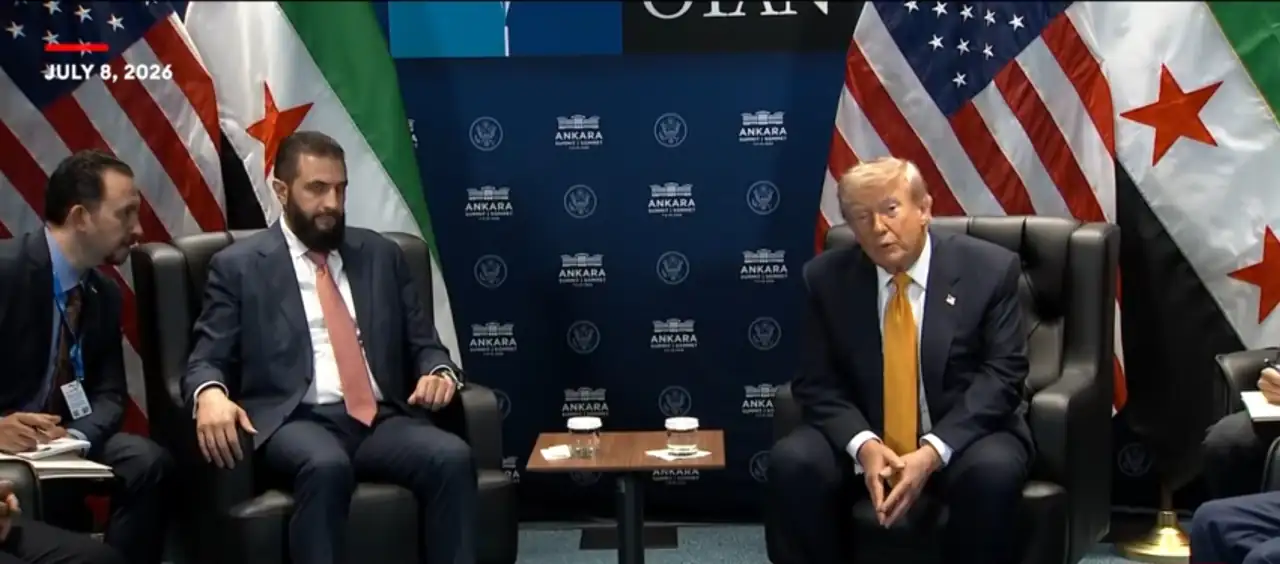
As you know, President Donald Trump also emphasized that Turkey’s hosting of the summit played a decisive role in his decision to attend. His remarks highlighting our personal friendship were especially meaningful and valuable to us. I once again thank my dear friend for his sincere appreciation.
Distinguished members of the press,
Turkey has been a member of NATO since 1952.
However, we are not merely another member of the Alliance. We are the heirs of a great nation whose military tradition spans more than two thousand years and has been forged through countless historic victories.
When Turkey joined NATO, we contributed not only our unique geostrategic position at the crossroads of three continents but also a military heritage refined over centuries of experience on the battlefield.
Our beloved Turkish Armed Forces possess the strength and capability to eliminate every threat to our national security at its source.
Today, we command NATO’s second-largest land force.
For decades, the security of NATO’s southeastern flank has largely rested upon Turkey’s shoulders, and we have faithfully fulfilled that responsibility.
We have always been an Ally that carries out its duties with commitment, shares burdens, and is willing to make sacrifices whenever necessary.
Turkey is among the leading contributors to NATO operations, missions, and common funding.
In this new era, where collective defense once again occupies the center of NATO’s strategy, we stand ready to assume even greater responsibility under the principle of fair burden-sharing.
Beginning in August, our F-16 fighter aircraft will be deployed to Estonia as part of NATO’s Air Policing Mission.
We will continue commanding the NATO KFOR mission in Kosovo until the end of September 2026.
Furthermore, Turkey will lead the NATO Response Force during 2028–2029.
Beyond these examples, we continue making significant contributions to numerous other NATO missions.
The Security and Defence Partnership Agreement signed today between Turkey and the United Kingdom is another important step in this regard.
Certainly, the amount of money spent on defense is important.
However, true deterrence depends on three essential pillars:
▪️Superior technology,
▪️Sufficient production capacity,
▪️Sustainable industrial capability.
These will form the strongest foundations of both deterrence and resilience in the years ahead.
Turkey’s Defense Vision, NATO Priorities, and Calls for Peace
President Recep Tayyip Erdoğan:
Ladies and gentlemen,
The remarkable progress Turkey has achieved in the defense industry over the past 23 years is well known.
Today, Turkey is among the few NATO Allies capable of producing its own fighter aircraft, battle tanks, naval vessels, and advanced air defense systems.
We rank among the world’s leading nations in unmanned aerial vehicles, unmanned naval systems, and warship production.
While equipping our own armed forces with domestically developed capabilities, we are also supporting our Allies through the export of Turkish defense products.
Distinguished members of the press,
As I stated earlier this morning, the European Union’s defense initiatives must complement NATO rather than create unnecessary duplication.
I continue to emphasize this important point at every opportunity and in every forum with both our NATO Allies and the leadership of the European Union.
It is a simple reality that if non-EU NATO Allies such as Turkey are not fully included in the Union’s defense initiatives, those efforts will remain significantly less effective.
At the same time, although some restrictions on defense trade among Allies have been reduced, various obstacles still remain.
These barriers should be removed completely, without conditions or exceptions.
We ensured that this issue was specifically reflected in the Summit Declaration.
Allow me to stress once again:
NATO should not become an alliance of countries dependent on one another, but an alliance of partners that strengthen one another.
Through the Defence Industry Forum we hosted during the Summit, our Allies also adopted the Ankara Strategy, which aims to deepen NATO’s cooperation with the defense industry.
Distinguished guests,
Terrorism remains one of the two principal threats facing NATO.
At every recent NATO Summit, we have discussed practical steps to strengthen our collective fight against terrorism.
At the Ankara Summit, we once again underlined the importance of sincere solidarity among Allies in combating terrorism.
During our discussions, we also addressed the war in Ukraine, which has now entered its fifth year.
This conflict has increasingly become a war of attrition, turning into a machine of destruction that claims tens of thousands of lives every single month.
From the very beginning of the conflict, Turkey has consistently advocated dialogue and diplomacy as the only path toward peace.
Our Allies are fully aware of this principled position.
Today, I would like to repeat one fundamental truth:
There are no losers in a just peace.
We reaffirmed Turkey’s readiness to once again bring the parties together on Turkish soil whenever they are prepared to negotiate.
Today, we also evaluated the latest developments in the Middle East.
We welcomed the Islamabad Agreement, a process that Turkey has supported at every stage.
We are fully aware of the challenges involved in negotiations.
However, what matters most is preserving the political will to reach a solution.
Even if setbacks occur from time to time, I firmly believe that common sense will ultimately prevail.
That is also what the international community expects—a genuine opportunity for peace.
At the same time, while hopes for peace are emerging in some areas, violence continues elsewhere.
Since March 2, nearly 5,000 people have lost their lives in Lebanon, where attacks continue without interruption.
People are being displaced from their homes, cities are being destroyed, and Lebanese territory is being occupied step by step.
Likewise, in Gaza—where 73,000 innocent people, the majority of them women and children, have been killed—occupation and oppression continue unabated.
Those who believe their own security depends upon instability throughout the region are attempting to extinguish even the smallest hope for peace.
We must not allow this war-driven mentality to prevail.
Our region cannot endure another escalation or another conflict.
On the contrary, humanity today needs peace, stability, and security as urgently as it needs air and water.
Bilateral Diplomacy, Future Summits, and Closing Remarks
President Recep Tayyip Erdoğan:
Distinguished members of the press,
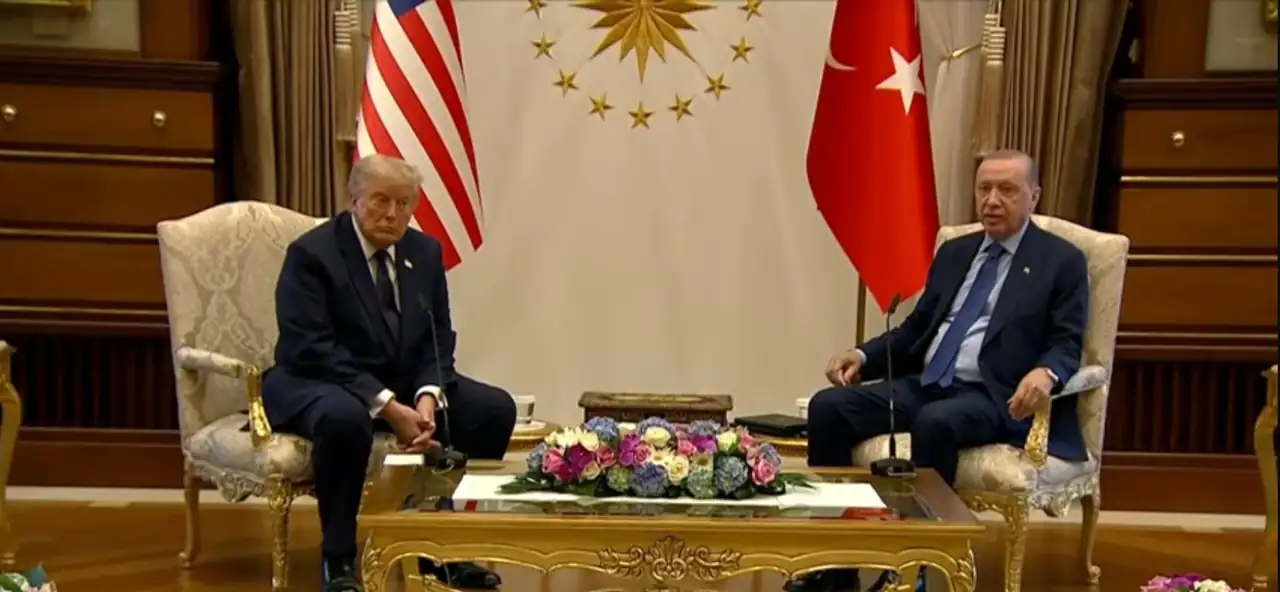
During the summit, I also held bilateral meetings with several leaders, particularly President Donald Trump, who paid an official visit to our country.
Our discussions focused on both bilateral relations and regional developments.
On the sidelines of the summit, I also met with the leaders of Bulgaria, Canada, Finland, France, Italy, Germany, and the United Kingdom.
Syrian President Ahmed al-Sharaa was also in Ankara.
Later this evening, we will attend a working dinner with the leadership of the European Union.
Tomorrow, we will welcome the leaders of Montenegro, Slovakia, and Albania.
As you know, next year marks the 75th anniversary of Turkey’s membership in NATO.
On the eve of this meaningful milestone, I would once again like to express my great satisfaction at hosting the NATO Summit here in our capital, Ankara.
I sincerely congratulate NATO Secretary General Mark Rutte and his team, with whom we worked in close cooperation throughout the summit preparations, as well as all the officials who worked tirelessly over the past several days to ensure the successful organization of this historic meeting.
I also extend my heartfelt gratitude to the people of Ankara, who once again demonstrated Turkey’s greatness and the hospitality of the Turkish nation to the entire world.
God willing, before the end of 2026, Turkey will host two more major international summits.
On 29–30 October, we will host the 13th Summit of the Organization of Turkic States here in Ankara.
Shortly afterward, between 9–20 November, we will host the COP31 Climate Summit in Antalya.
With these thoughts, I hope the NATO Ankara Summit will bring peace and positive outcomes for all.
I thank all members of the press who have traveled from around the world for your interest and participation.
Now, I would like to take your questions.
Q&A Session: F-35s, the Steel Dome, and Relations with Greece
Reporter (TRT Haber):
Mr. President, your remarks regarding the possible addition of F-35 fighter jets to Turkey’s fleet have received significant international attention.
However, I’d like to mention two reactions.
The first came from the Israeli Prime Minister, who said he opposes the sale of F-35s to Turkey, claiming that it could enable Turkey to pursue what he described as “expansionist ambitions.”
The second reaction came from one of our NATO allies. Greek Prime Minister Kyriakos Mitsotakis also opposed the sale, arguing that Turkey poses a serious military threat because of the ongoing disputes over maritime boundaries.
How do you assess these statements?
Could they complicate the F-35 process from a diplomatic perspective?
President Recep Tayyip Erdoğan:
Neither of those statements has any place in my world.
Everyone knows what waters Mr. Netanyahu is navigating.
As for Mr. Mitsotakis, I don’t think he should have fallen into such a mistake.
Have we ever questioned why Greece purchases certain defense systems?
Have we ever asked, “Why did you buy them?” or “Why are you buying them?”
No.
Even though Greece is our immediate neighbor, we have never taken such an approach.
Turkey also has every right to purchase defense equipment.
In fact, Turkey is no longer merely buying such systems—we are producing them ourselves.
At the same time, we continue discussions with various countries around the world regarding our defense needs, and we will continue taking the necessary steps accordingly.
Reporter (Reuters):
Mr. President, during your meeting with President Trump there appeared to be positive signals regarding the F-35 issue.
However, during his press conference he said that he had not yet made a final decision.
What exactly did he tell you regarding the F-35 program?
Secondly, under U.S. legislation, Turkey’s possession of the S-400 system remains an obstacle to rejoining the F-35 program.
What does Turkey intend to do with the S-400s?
Would Turkey return them to Russia or deploy them in another country?
President Recep Tayyip Erdoğan:
Thank you.
Just keep following us.
Reporter (Sabah Digital):
Mr. President, the allocation of $24 billion for the Steel Dome Project demonstrates Turkey’s determination to achieve complete independence in air defense.
How will this ambitious project strengthen not only Turkey’s own security but also NATO’s overall air defense capabilities?
How do you assess the interest shown by our Allies?
President Recep Tayyip Erdoğan:
The Steel Dome Project is also one of NATO’s strongest strategic assets in our region.
We have already taken all the necessary steps.
Turkey continues to make progress every single day.
We have demonstrated these capabilities before, we continue to demonstrate them, and we will keep doing so.
If others have their own defense “domes,” then Turkey has its own Steel Dome.
Reporter (Azerbaijan Press Agency):
Mr. President, did you discuss developments in the South Caucasus during your meeting with President Trump?
Was regional peace in the South Caucasus part of your discussions?
President Recep Tayyip Erdoğan:
The South Caucasus was not part of our discussions today.
However, I can speak with President Trump about such matters at any time by telephone.
Thank you.
Reporter (A Haber):
Mr. President, Prime Minister Mitsotakis recently stated that Turkey and Greece should resolve their maritime disputes and said relations have entered a constructive period.
After so many years of dialogue, what could be the next step in Turkish-Greek relations?
Secondly, did the issue of the Halki Seminary come up during your discussions with President Trump?
President Recep Tayyip Erdoğan:
No, the Halki Seminary was not discussed.
As for Mr. Mitsotakis, I share his view that the issues concerning the Aegean Sea should be resolved.
First, our foreign ministers should continue their work.
If necessary, we as leaders can then meet to discuss these matters directly.
Let me say this clearly:
Resolving these issues is, above all, the responsibility of the leaders.
I fully share that understanding.
Q&A Session: Mediation, U.S.-Turkey Relations, and Defense Cooperation
Reporter:
Mr. President, Turkey has become widely recognized as a peace-builder and an exceptional mediator under your leadership.
Many leaders—including President Trump—have expressed their desire to work with you on resolving international disputes.
Given the differences that remain among NATO allies over issues such as Russia-Ukraine and Iran, do you believe Turkey will take on new mediation roles following this NATO Summit?
President Recep Tayyip Erdoğan:
I firmly believe that a fairer world is possible, and we must continue working toward that goal.
Every political leader who believes in peace has a responsibility to think, act, and take concrete steps to resolve these problems.
I never say that these issues are impossible to solve.
On the contrary, I believe they can be solved.
We will continue making every effort.
President Trump, along with leaders across the world, must show determination and commitment.
Those whose priority is peace should contribute in every possible way.
Reporter (A Haber):
Mr. President, since President Trump arrived in Turkey, you have spent considerable time together.
You held informal discussions, a lengthy joint press conference, and later a bilateral meeting.
Could you elaborate on the main issues discussed?
Also, what feedback have you received from other leaders regarding the NATO Summit in Ankara?
President Recep Tayyip Erdoğan:
Our joint press conference with President Trump at the Presidential Complex was very comprehensive.
As members of the press, you were there, and I believe you had every opportunity to follow what was discussed.
Both President Trump and I answered all the questions put before us.
It was an extremely productive meeting.
When we left the press conference, President Trump was very pleased.
Reporter (Milliyet):
Mr. President, how have NATO allies responded to Turkey’s proposal to establish a NATO-accredited Centre of Excellence for Counter-Unmanned Systems, drawing on Turkey’s extensive experience with unmanned technologies?
How could such a center contribute to NATO’s strategy in the Black Sea and Aegean regions?
President Recep Tayyip Erdoğan:
Those directly involved in establishing these Centers of Excellence will provide more detailed information when the time is appropriate.
However, Turkey already possesses significant expertise and capabilities in this field.
We continue to demonstrate both our technological strength and the work carried out by our Centers of Excellence.
Baykar is one of the most important examples of this success.
The company continues to receive a large number of international orders.
This clearly demonstrates that Turkish unmanned aerial systems have earned worldwide recognition.
Reporter (TRT World):
Mr. President, following President Trump’s visit, many expect a new chapter in U.S.-Turkey relations.
What concrete steps do you anticipate in areas such as trade, defense cooperation, and regional security?
Which area do you see as the highest priority for bilateral cooperation?
President Recep Tayyip Erdoğan:
Naturally, defense cooperation remains one of our highest priorities.
At the same time, expanding our economic relationship with the United States is equally important.
Strengthening our economic ties serves Turkey’s national interests, and the United States shares that view.
We intend to continue moving forward in this direction.
President Trump and I are in agreement on these matters.
One of the most important issues discussed was the F-35 program.
President Trump has adopted a positive approach toward Turkey.
God willing, when the F-35 aircraft are delivered to Turkey, the entire world will see that the United States has honored its commitment.
Q&A Session: Democracy, a Terror-Free Turkey, and Final Remarks
Reporter (Star Newspaper):
Mr. President, Turkey is hosting a NATO Summit for the second time. The first was held in Istanbul in 2004, during the early years of your government, and now, in 2026, the summit has been hosted in Ankara.
Next week marks the 10th anniversary of the July 15 coup attempt. Over the years, Turkey has made significant progress not only in strengthening its defense industry and military but also in consolidating its democracy after overcoming major challenges, including the July 15 events.
How do you assess Turkey’s democratic progress since 2004, particularly in light of the July 15 anniversary?
President Recep Tayyip Erdoğan:
With regard to July 15, our government has successfully advanced the vision of a terror-free Turkey.
Today, shepherds in southeastern and eastern Turkey can freely graze their flocks on the highlands without fear.
Parents can confidently entrust their children with those responsibilities.
People are now able to swim safely in our rivers and streams.
We hold public meetings and rallies across the region without difficulty.
These are clear signs of how far we have come in building a Turkey free from terrorism.
Our party continues to organize rallies throughout the region, and we are grateful to God for enabling us to achieve these successes.
President Recep Tayyip Erdoğan:
Thank you all very much for your questions and for your interest.
I once again thank all members of the press from around the world for following the NATO Ankara Summit.
May the decisions taken during this summit contribute to peace, security, and stability for our region and the world.
Thank you very much.