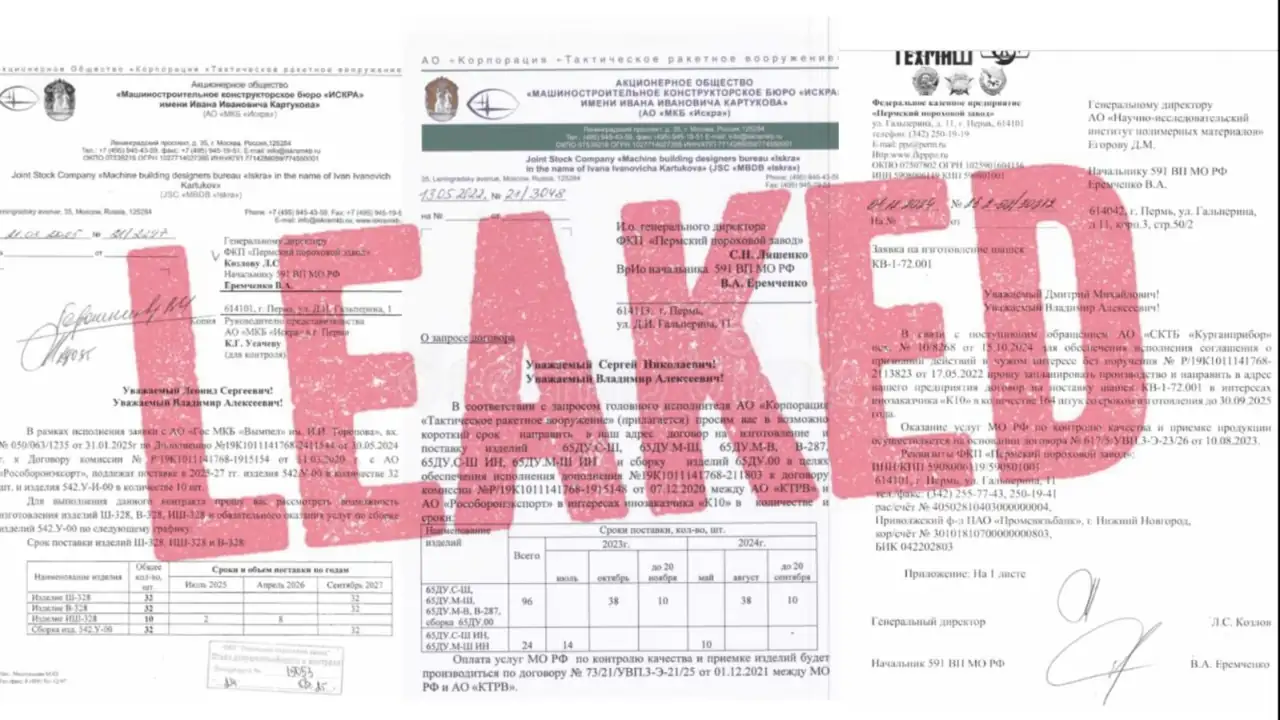
Leaked internal Russian documents have exposed details of a significant arms transfer from Moscow to Tehran, including hundreds of advanced air-to-air and air-to-ground missiles intended for Iran’s anticipated fleet of Sukhoi Su-35 fighter jets. The revelations, first publicized by Ukraine’s UNITED24 Media, highlight the deepening military cooperation between Russia and Iran, with deliveries and component orders extending through 2027.
Missile Inventory for Iran's Su-35s
According to the contracts, Russia is supplying the following munitions:
Kh-38 (X-38): 120 units — Laser-guided air-to-ground missiles, offering precision strike capabilities with a range of up to approximately 40 km.
R-73: 123 units — Short-range air-to-air missiles, highly maneuverable for close-quarters dogfights.
R-77: 42 units — Medium-range air-to-air missiles, enabling beyond-visual-range engagements.
Kh-31 (X-31): 42 units — Anti-radar and anti-ship missiles, designed to suppress enemy air defenses and target naval assets.
These weapons are explicitly tied to Iran’s Su-35 procurement program. Production and delivery schedules for aircraft components and associated munitions are ongoing, reflecting a long-term commitment.
In the Russian documentation, Iran is consistently referred to by the code name “K10”. This designation appears across multiple contracts and correspondence involving Russian defense entities like Irkut Corporation and KnAAZ (Komsomolsk-on-Amur Aircraft Plant). One document explicitly links “K10” to Iran, confirming the customer’s identity.
The broader framework traces back to an export contract (reportedly numbered R/1936411141768 or similar variants) signed around June 2021. While earlier leaks detailed the production of around 16 Su-35 jets for Iran with deliveries phased into 2025–2027, the newer missile contracts focus on arming these aircraft.
The supplies significantly enhance Iran’s air combat capabilities. The Islamic Republic has long relied on an aging fleet of pre-1979 U.S. and Soviet-era aircraft, supplemented by limited domestic production. Acquiring modern Su-35 multirole fighters equipped with these missiles would mark a major upgrade, potentially allowing Iran to project power more effectively against regional adversaries, including U.S. and Israeli forces.
Analysts note that air-to-air missiles like the R-77 could challenge superior Western aircraft in certain scenarios, while the Kh-38 and Kh-31 provide potent options for precision strikes and defense suppression. This transfer occurs amid broader Russia-Iran military ties, including Iranian drone supplies to Russia for use in Ukraine and reciprocal technology exchanges.
The leaks come at a sensitive time, with ongoing conflicts in the Middle East and Russia’s war in Ukraine straining global arms dynamics. Ukrainian sources, which obtained and analyzed the documents, frame the revelations as evidence of a sustained axis between Moscow and Tehran.
Russia has historically denied or downplayed certain arms deals with Iran, but independent verification of similar leaks (including prior Su-35 production details) lends credibility to these reports. Western governments and Israel are likely to view the development with alarm, potentially prompting renewed diplomatic or sanctions pressure.
As more details from the leaked files emerge, they underscore the opaque nature of Russia-Iran defense cooperation and its potential to reshape the balance of power in the Middle East and beyond. UNITED24 Media and other outlets continue to release supporting documentation, including contract excerpts and delivery timelines.