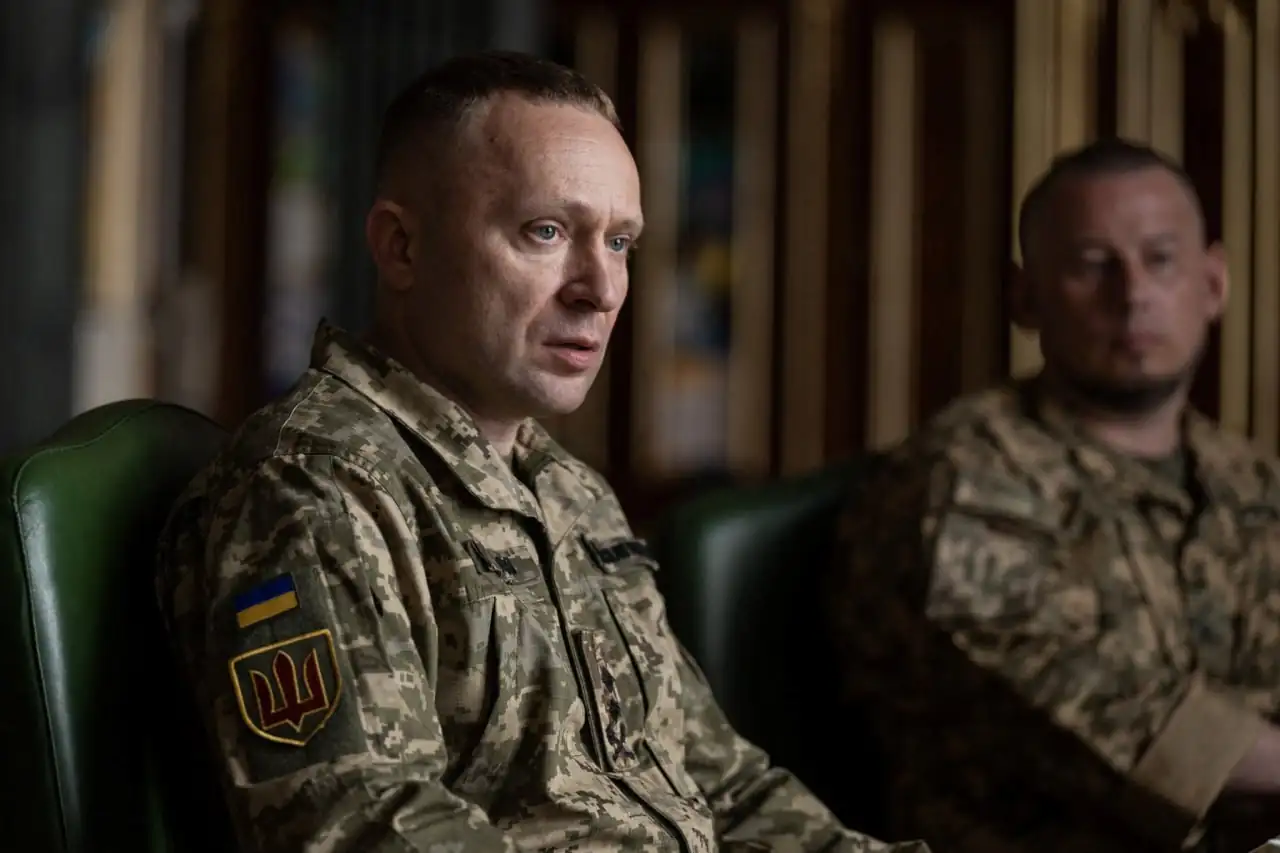
On July 21–22, 2026, Ukrainian President Volodymyr Zelenskyy appointed Major General Mykhailo Drapatyi as the new Commander-in-Chief of the Armed Forces of Ukraine. He replaces General Oleksandr Syrskyi, whose departure followed days of widespread protests in Kyiv and other cities. The unrest was triggered by the earlier dismissal of Defense Minister Mykhailo Fedorov, amid reported tensions between Fedorov and Syrskyi over military reforms, strategy, and command style.
Drapatyi, a 43-year-old battle-hardened officer (born November 21, 1982, in Kamianets-Podilskyi, Khmelnytskyi Oblast), is widely viewed as a reform-minded, soldier-focused leader. His appointment is seen as a response to public demands for change, a shift toward modernization, and greater accountability in the military.
Drapatyi graduated from the Kharkiv Institute of Tank Troops in 2004 and began his service as a lieutenant in the 72nd Separate Mechanized Brigade. He quickly rose through the ranks as a career officer trained in independent Ukraine’s post-Soviet system.
His national fame came in May 2014 during the Battle of Mariupol. As a major commanding the 2nd Mechanized Battalion, Drapatyi led a daring operation where his BMP-2 infantry fighting vehicle famously rammed through a separatist barricade—earning him the nickname “The Flying BMP.” He also played a key role in the successful breakout from the Izvaryne encirclement, helping save hundreds of Ukrainian personnel and equipment.
Subsequent commands included chief of staff and deputy commander of the 30th Mechanized Brigade, and commander of the 58th Motorized Infantry Brigade (2016–2019), where his units operated in intense Donbas sectors like Avdiivka and near Bakhmut. He later advanced through staff and operational roles, including studies at the National Defense University of Ukraine.
Full-Scale Invasion and Key Commands
During Russia’s 2022 full-scale invasion, Drapatyi held critical positions, including deputy commander for training in the Joint Forces and command of operational groups in the south. He contributed significantly to halting Russian advances toward Kryvyi Rih and to the successful Capture of the right-bank Kherson region.
In 2024, he served as Deputy Chief of the General Staff for training, then took command of the Kharkiv Operational-Tactical Group amid a Russian offensive. Ukrainian forces stabilized the sector under his leadership and conducted limited counteractions. He was promoted to Major General and appointed Commander of the Ground Forces in late 2024, where he initiated reforms in recruitment, training, technology integration (especially drones), and command culture.
In June 2025, following a tragic Russian strike on a training ground that killed 12 soldiers and wounded dozens, Drapatyi publicly took responsibility and resigned as Ground Forces commander, a rare act of accountability in military leadership. He was soon reassigned to command the Joint Forces, continuing to influence operations and advocate for systemic changes.
Drapatyi is a decorated officer: full Knight of the Order of Bohdan Khmelnytsky, recipient of the Cross of Military Merit, and other honors. He is married with two children.
Leadership Style and Reforms
Drapatyi stands out for his emphasis on decentralization, empowering junior commanders, innovation particularly drones and asymmetric tactics, and a “soldier-first” approach that contrasts with more centralized, Soviet-style methods. He has publicly criticized cultures of “mutual cover-ups and impunity,” pushed for better training and accountability, and supported broader military transformation alongside figures like Fedorov.
His appointment, alongside Maj. Gen. Ihor Skybiuk as Chief of the General Staff, is interpreted as a signal of continuity in defensive efforts paired with accelerated reforms. Zelenskyy has tasked the new team with intensifying offensives, planning deep strikes, developing technology, and strengthening capabilities.
Challenges for Russia
Drapatyi’s rise poses several potential challenges for Russian forces:
Reform and Innovation: His focus on drones, electronic warfare, better training, and decentralized decision-making could enhance Ukrainian adaptability and reduce losses, making sustained Russian advances more costly.
Morale and Unity: The appointment has received broad support from protesters, military personnel, and reform advocates, potentially stabilizing Ukraine’s internal front and boosting troop morale after recent political turbulence.
Operational Experience: With proven success in defensive stabilization (Kharkiv, Kherson) and offensive planning, Drapatyi brings fresh perspective to ongoing operations in Donetsk and elsewhere. His emphasis on logistics disruption and asymmetric actions could complicate Russian supply lines and force posture.
Russia will likely face a Ukrainian military increasingly oriented toward technological edge, accountability, and efficient resource use—factors that could prolong the war of attrition and raise the costs of any territorial gains. However, massive challenges remain for Ukraine: manpower, munitions, air defense, and the sheer scale of Russian resources.
Drapatyi himself acknowledged the weight of the role: “Serving Ukraine has always been an honor… during the war for independence, it means absolute responsibility.” His leadership will be tested in delivering results on the battlefield while implementing the reforms many Ukrainians demand.
This appointment marks a generational and doctrinal shift in Ukraine’s high command, one that could shape the next phase of the conflict.