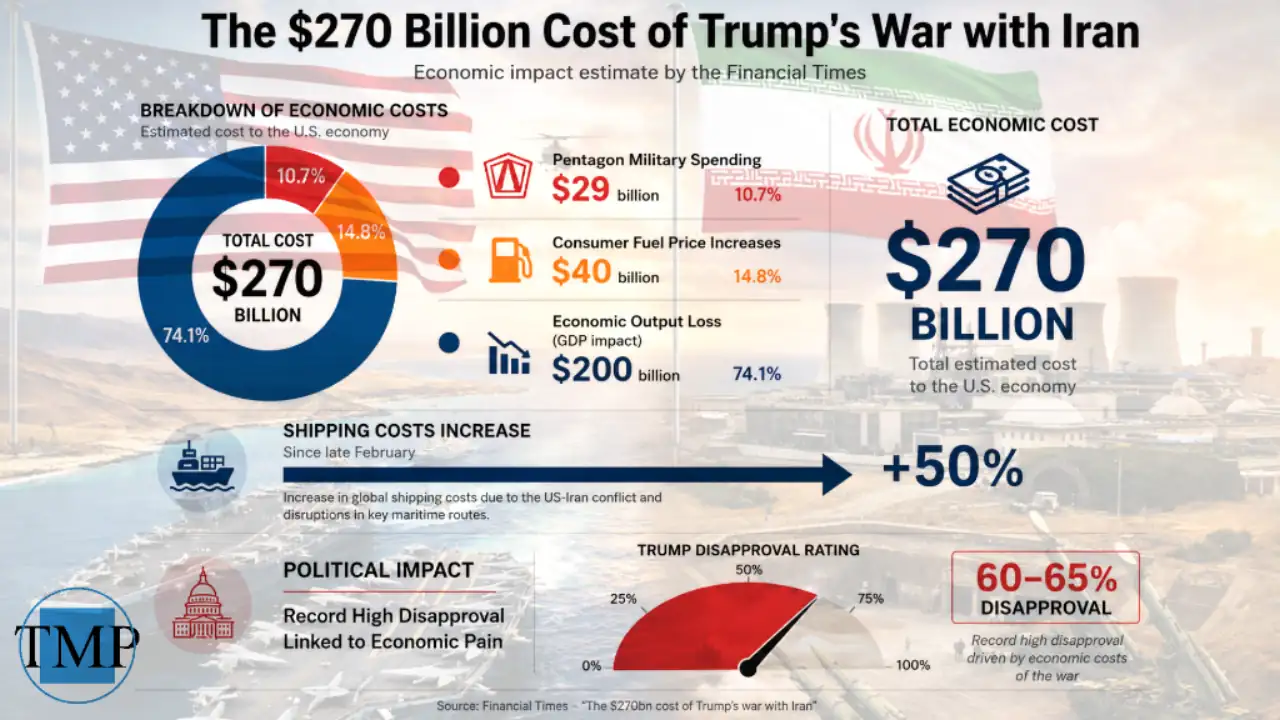
In a scathing analysis, the Financial Times has laid bare the staggering economic toll of the ongoing U.S. military conflict with Iran, estimating that the war has already cost the American economy more than $270 billion. As midterm elections loom in November, this financial burden is emerging as a central factor in President Donald Trump’s sinking approval ratings, with voters increasingly linking rising costs at the pump, inflation, and economic uncertainty directly to the administration’s foreign policy decisions.
The Pentagon’s initial estimate for direct military expenditures stands at $29 billion, primarily allocated for missiles, interceptor systems, and other munitions. Defense officials have warned that this figure is expected to climb rapidly as operations continue.
Beyond the battlefield, the war’s ripple effects have hit American households hard:
▪️Fuel prices: U.S. consumers have shelled out more than $40 billion in additional costs due to surging energy prices triggered by disruptions in global oil supplies.
▪️Broader economic drag: War-induced inflation has constrained the Federal Reserve’s ability to cut interest rates. Economists calculate a resulting loss of approximately $200 billion in economic output, translating to higher credit card debt, more expensive mortgages, and slowed growth.
▪️Shipping chaos: The closure of the Strait of Hormuz, a critical chokepoint for global energy trade, has caused shipping costs on key routes to spike by over 50% since late February. This has exacerbated supply chain pressures and contributed to broader price increases.
Adding these elements together, the Financial Times arrives at its eye-watering $270 billion total, a “back of the envelope” calculation that underscores how quickly a regional conflict can impose massive domestic costs.
The economic pain is translating directly into political trouble for President Trump. Recent polls show his approval rating hovering in the mid-to-low 30s, marking some of the weakest numbers of his second term.
A Reuters/Ipsos poll found overall approval dipping, with just 22% approving of his handling of the cost of living.
Multiple surveys, including those from Fox News, Pew, and NYT/Siena, indicate disapproval of Trump’s handling of the Iran conflict ranging from 59% to 61%.
Economic approval has fallen sharply, with voters citing inflation, gas prices, and personal finances as top concerns.
With midterms approaching, Trump’s political fate appears increasingly tied to resolving the crisis. Public opposition to the war has grown even as many believe the U.S. holds a military edge, reflecting frustration that the conflict is “not a war of the American people” but one they are paying for at the checkout line.
Critics argue that the administration underestimated the economic blowback from disrupting roughly one-fifth of global oil flows. Supporters counter that decisive action was necessary against Iranian threats, but the pocketbook impact is proving hard to ignore for independent and even some Republican voters.
As efforts continue to stabilize shipping lanes and negotiate de-escalation, the Financial Times report serves as a stark reminder of modern warfare’s hidden price. For the White House, the challenge is clear: contain the conflict before the $270 billion and counting becomes a decisive political liability in November. Americans are feeling the costs not just in national security briefings, but in their daily budgets and they are holding leadership accountable.