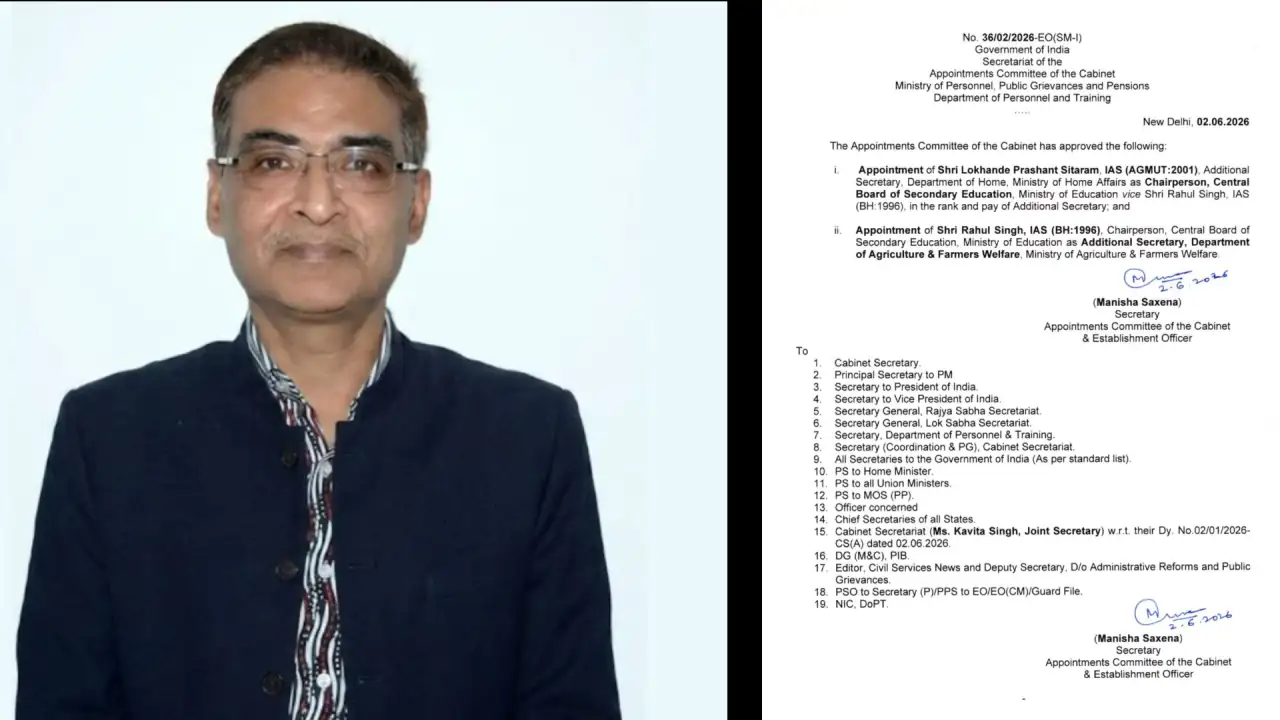
In what the government is quietly projecting as firm accountability, former CBSE Chairperson Rahul Singh has been moved out of the education board and appointed as Additional Secretary in the Department of Agriculture and Farmers Welfare. The move has triggered sharp criticism, with many calling the so-called “tough action” little more than a bureaucratic shuffle dressed up as punishment.
The timing is notable. Rahul Singh’s transfer comes amid serious allegations surrounding the On-Screen Marking (OSM) system used for Class 12 examinations. Glitches, questionable tendering worth hundreds of crores, and widespread complaints from students about faulty evaluation have put the CBSE under intense scrutiny. Yet instead of a demotion, suspension, or any visible penalty, the senior IAS officer has simply been relocated to another ministry.
Critics argue that transferring a high-profile education administrator to the Agriculture Ministry is hardly the “tough action” it is being made out to be. Education is one of the most sensitive and politically visible sectors, directly affecting millions of students and their futures. Agriculture, while important, is often seen in bureaucratic circles as a relatively lower-pressure assignment compared to managing one of India’s largest and most controversial examination boards.
Many on social media have pointed out the irony with biting sarcasm: “What a tough action, from CBSE boss to Agriculture Secretary. Accountability achieved.” The tone reflects a growing perception that senior officials involved in major institutional failures are rarely held truly accountable and are instead quietly reassigned to other departments.
Along with Singh, CBSE Secretary Himanshu Gupta has also been sent back to his parent cadre with restrictions. In their places, the government has appointed Lokhande Prashant Sitaram as the new Chairperson and Varun Bhardwaj as Secretary. While the new team may bring fresh energy, the larger question remains: does merely changing faces at the top solve deep-rooted systemic issues like opaque tendering and unreliable digital evaluation systems?
The On-Screen Marking project, which was meant to modernize and bring transparency to answer sheet evaluation, has instead become a major embarrassment. Reports suggest technical failures, poor image quality, and possible irregularities in awarding a massive contract to a private vendor. A formal inquiry is now underway, but many wonder why such problems were allowed to escalate to this level in the first place under the previous leadership.
Parents and students have expressed frustration that after enduring the anxiety of board exams, they now face uncertainty over results due to a flawed digital system. In this context, simply transferring the top officials feels more like damage control than decisive reform.
This episode highlights a familiar pattern in Indian governance: when controversies erupt in high-visibility departments, the response is often a quiet bureaucratic reshuffle rather than structural overhaul or visible consequences for those at the helm. Rahul Singh, a 1996-batch IAS officer, moves on with his career intact. The students whose academic futures may have been impacted by the OSM mess, however, get no such easy transition.
Whether this transfer will actually improve things at CBSE or in the Agriculture Ministry remains to be seen. For now, the dominant public sentiment is one of skepticism. “Tough action” sounds good in official statements, but when it looks this convenient, it raises more questions than it answers.
The new CBSE leadership has its work cut out, restoring credibility, fixing the evaluation mess, and proving that this leadership change is more than just another routine rotation of chairs.