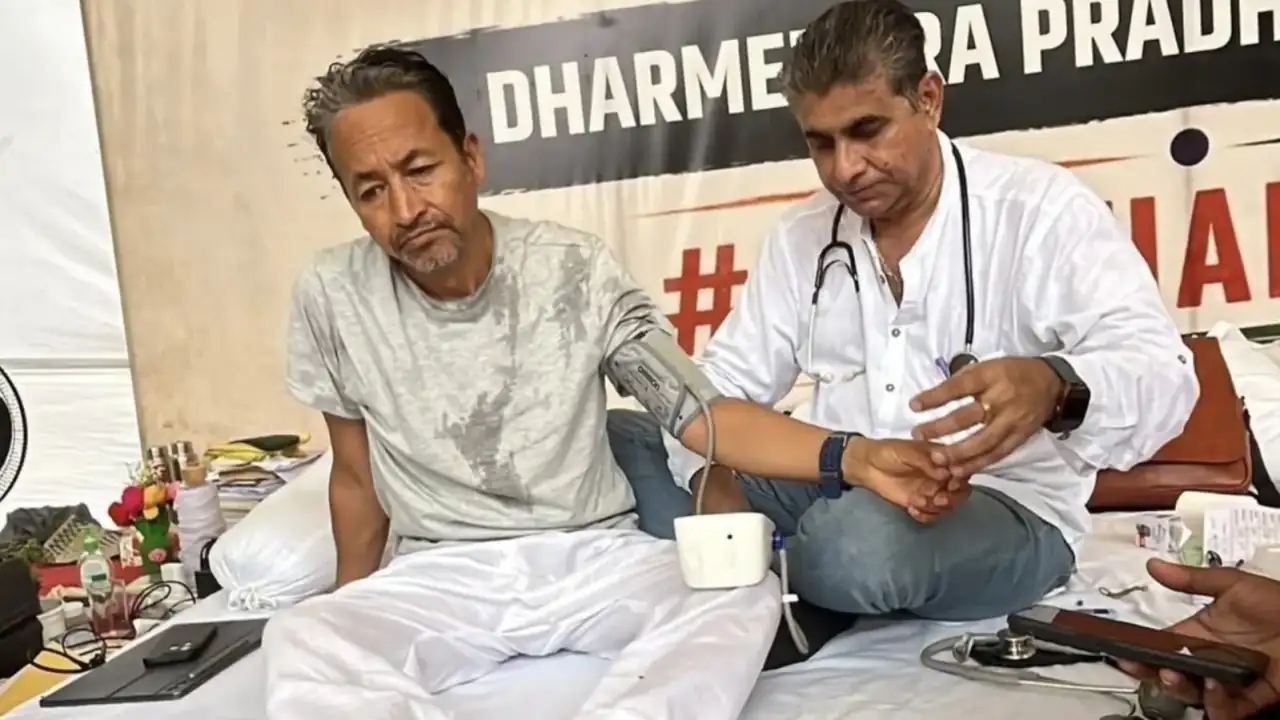
Renowned Ladakhi education reformer, climate activist, and Ramon Magsaysay Award winner Sonam Wangchuk is on the 19th day of his indefinite hunger strike at Delhi’s Jantar Mantar. Having joined the youth-led Cockroach Janta Party (CJP) protest on June 28, Wangchuk continues his fast amid steadily declining health, underscoring what critics describe as the central government’s apparent reluctance to engage with peaceful demonstrators raising legitimate concerns over education integrity and regional autonomy.
Wangchuk’s demands are twofold: the resignation of Union Education Minister Dharmendra Pradhan over the alleged NEET-UG 2026 paper leaks, which affected over 22 lakh students and reportedly led to multiple student suicides, and the long-pending implementation of Sixth Schedule protections for Ladakh to safeguard its tribal identity, land, and resources following the 2019 revocation of Article 370.
Medical updates paint a concerning picture. Reports indicate Wangchuk has lost nearly 8-9 kg, with recent readings showing low blood pressure (around 105/61 mmHg) and blood sugar levels at 80 mg/dL. Doctors have warned of risks including organ damage if the fast continues without intervention. Despite this, Wangchuk has refused to break his fast without substantive government talks, stating in a recent message: “Even if I eat, what will change and what message will go? The message will go to the government that there is no need to answer (to the protesters).”
The Delhi High Court has stepped in, accepting the Centre’s assurance for daily medical checks and monitoring by government doctors while emphasizing that “the life of any citizen is precious” and urging authorities to do whatever is necessary to protect it.
The ongoing protest highlights a stark contrast with past instances where governments responded to high-profile hunger strikes. Despite weeks of peaceful demonstrations drawing students, opposition leaders, actors, and civil society, the Union government has offered no direct dialogue or concrete assurances on the core demands. Critics argue this silence reflects an inability or unwillingness, to address systemic issues in competitive examinations and fulfill electoral promises made to Ladakh.
Protesters and supporters point out that even during the British era, authorities engaged with such non-violent actions. The lack of response here, they say, risks eroding public trust and signals that peaceful advocacy may yield little from those in power.
Statements from Officials and Opposition Leaders
Government/Official Side:
“Pradhan has dismissed CJP and its supporters as ‘the B-team of disruptive elements’.”
— Reports on Minister Dharmendra Pradhan’s stance.
The government has maintained a largely non-responsive approach, with limited official comments beyond assurances to the court on medical care.
Opposition and Supporters:
“You have awakened the conscience of the nation…”
— Congress MP Shashi Tharoor, appealing to Wangchuk while criticizing the lack of accountability.
Opposition leaders including Mamata Banerjee, Akhilesh Yadav, Arvind Kejriwal, and Uddhav Thackeray have issued public statements supporting the demands and urging dialogue.
One protester noted: “There has been no kind of response from the government. They have left Sonam Wangchuk to die.”
As Wangchuk’s condition worsens and calls grow for mass participation in upcoming protests such as on July 20, the episode raises broader questions about democratic responsiveness. Will the government break its silence and engage, or will the health of a respected figure like Sonam Wangchuk continue to deteriorate amid institutional inertia? The coming days may prove decisive.