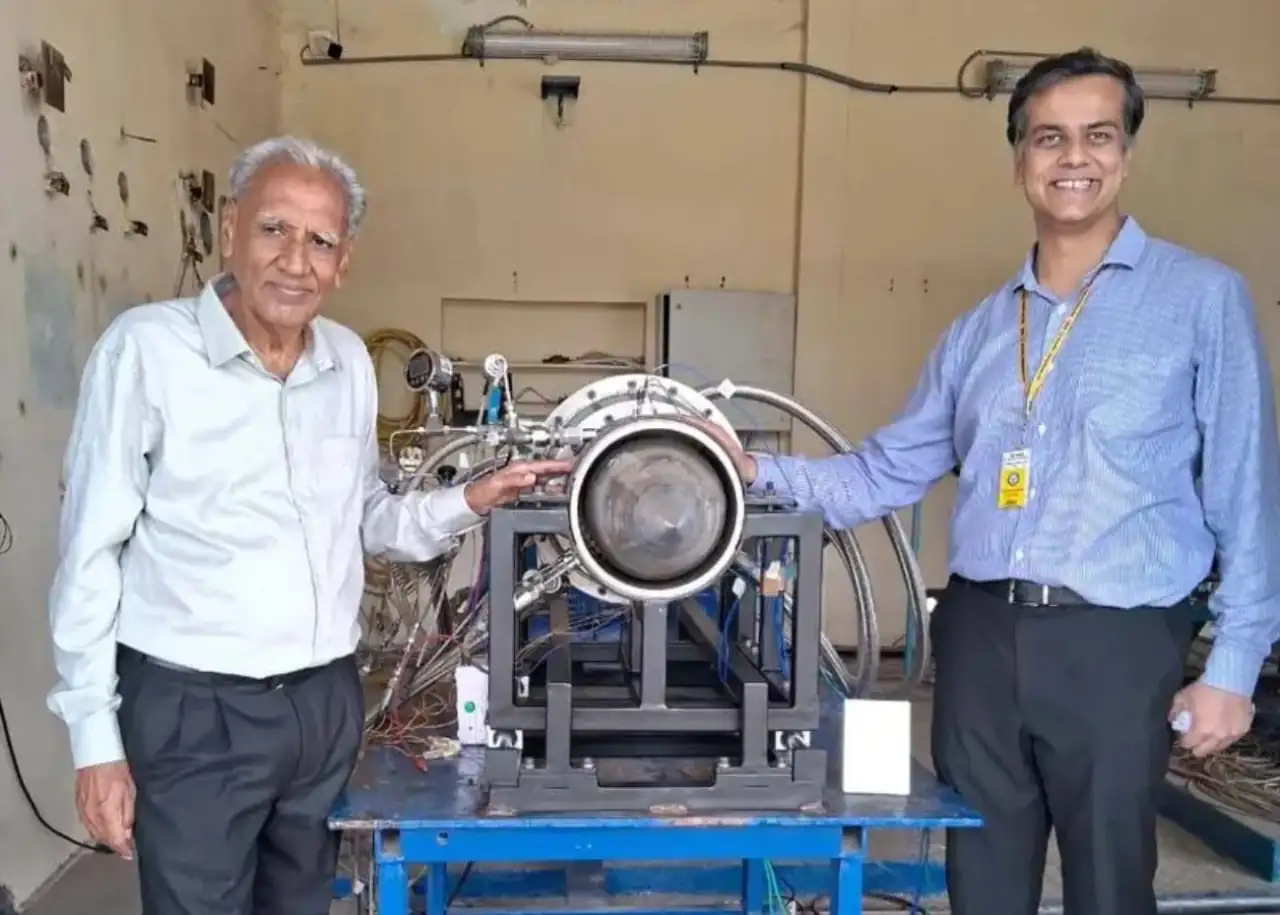
In a significant leap for India’s aerospace and defence capabilities, IIT Madras-incubated startup D-Propulse has successfully tested a next-generation air-breathing Rotating Detonation Engine (RDE) at a Defence Research and Development Organisation (DRDO) facility. The engine produced 5 kN of thrust even under limited air supply conditions and has reached Technology Readiness Level 5 (TRL-5), validating it in realistic operational environments beyond pure laboratory settings.
The test, conducted in mid-July 2026, marks one of the most advanced propulsion demonstrations by an Indian private entity. D-Propulse integrated the RDE with a special aerospike nozzle, enabling consistent performance across altitudes, unlike conventional bell-shaped nozzles that are optimised only for specific atmospheric conditions.
How the Rotating Detonation Engine Works
Traditional jet and rocket engines rely on subsonic deflagration, essentially a steady flame that burns fuel relatively slowly. In contrast, an RDE sustains continuous supersonic detonation waves that spin around a ring-shaped (annular) combustion chamber. This pressure-gain combustion process delivers higher thermodynamic efficiency, generating more thrust from less fuel while requiring fewer moving parts and reducing mechanical complexity.
Experts estimate RDEs can offer efficiency gains of around 25% or more compared to conventional systems, along with improved thrust-to-weight ratios. The successful 5 kN demonstration under reduced air mass flow further highlights the design’s robustness and potential for optimisation in future tests.
D-Propulse, founded in 2025, is led by Founder and CEO Saurav Jha and Co-founder & CTO Dr. V. Ramanujachari, a former senior DRDO scientist with experience on India’s scramjet and Akash missile propulsion programmes. The company is chaired by former DRDO chief and NITI Aayog member Dr. Vijay Kumar Saraswat (Padma Shri and Padma Bhushan), who joined the Board in June 2026 specifically to guide the rapid progression of the RDE through higher technology readiness levels. The programme is also advised by combustion expert Prof. S.R. Chakravarthy of IIT Madras.
The achievement places India among a small group of nations actively developing practical RDE technology, with potential applications spanning hypersonic aircraft, cruise missiles, high-speed UAVs, and reusable launch vehicles. It strengthens indigenous propulsion capabilities and supports the broader goal of reducing dependence on foreign technology under the Aatmanirbhar Bharat initiative.
Scientists and Experts Speak
“The engine has now successfully achieved TRL-5. This means it has moved beyond basic laboratory tests and been validated as a prototype capable of handling realistic physical stresses. This is a very big achievement. The 5 kN thrust was generated even with reduced air mass flow, showing that further optimisation in upcoming test campaigns can unlock even higher performance.”
— Saurav Jha, Founder & CEO, D-Propulse
“We have entered an era where speed is the new stealth. Defence budgets across major power centres are pivoting in recognition of this reality. Our vision is to ensure India is fully equipped not merely to navigate but potentially dominate the emerging era of high-supersonic and hypersonic systems. Towards that end, we are progressing indigenous air-breathing rotating detonation engine technology.”
— Saurav Jha, Founder & CEO, D-Propulse
“Rotating Detonation Engines represent a fundamental shift from conventional combustion. By using continuous supersonic detonation waves in an annular chamber, we achieve pressure-gain combustion that delivers higher efficiency and thrust with a simpler mechanical architecture. Integrating the aerospike nozzle further ensures altitude-independent performance—critical for future multi-regime aerospace platforms.”
— Dr. V. Ramanujachari, Co-founder & CTO, D-Propulse (former senior DRDO scientist)
“I have joined the Board of D-Propulse as Chairman to oversee the company’s rapid ascent through technology readiness levels for its cutting-edge RDE technology. Indigenous development of advanced propulsion systems such as the rotating detonation engine is essential for securing India’s strategic advantage in high-speed aerospace and defence platforms.”
— Dr. V.K. Saraswat, Chairman, D-Propulse (Former Secretary, DRDO & Past Member, NITI Aayog)
The path ahead involves further endurance testing, thermal management improvements, and progressive TRL advancement toward flight-ready systems. With sustained support, D-Propulse’s work could help redefine the performance envelope of Indian high-speed platforms - delivering greater range, higher speeds, and improved efficiency in a compact package.
This breakthrough not only advances India’s technological self-reliance but also positions the country as an emerging player in one of the most promising frontiers of aerospace propulsion.