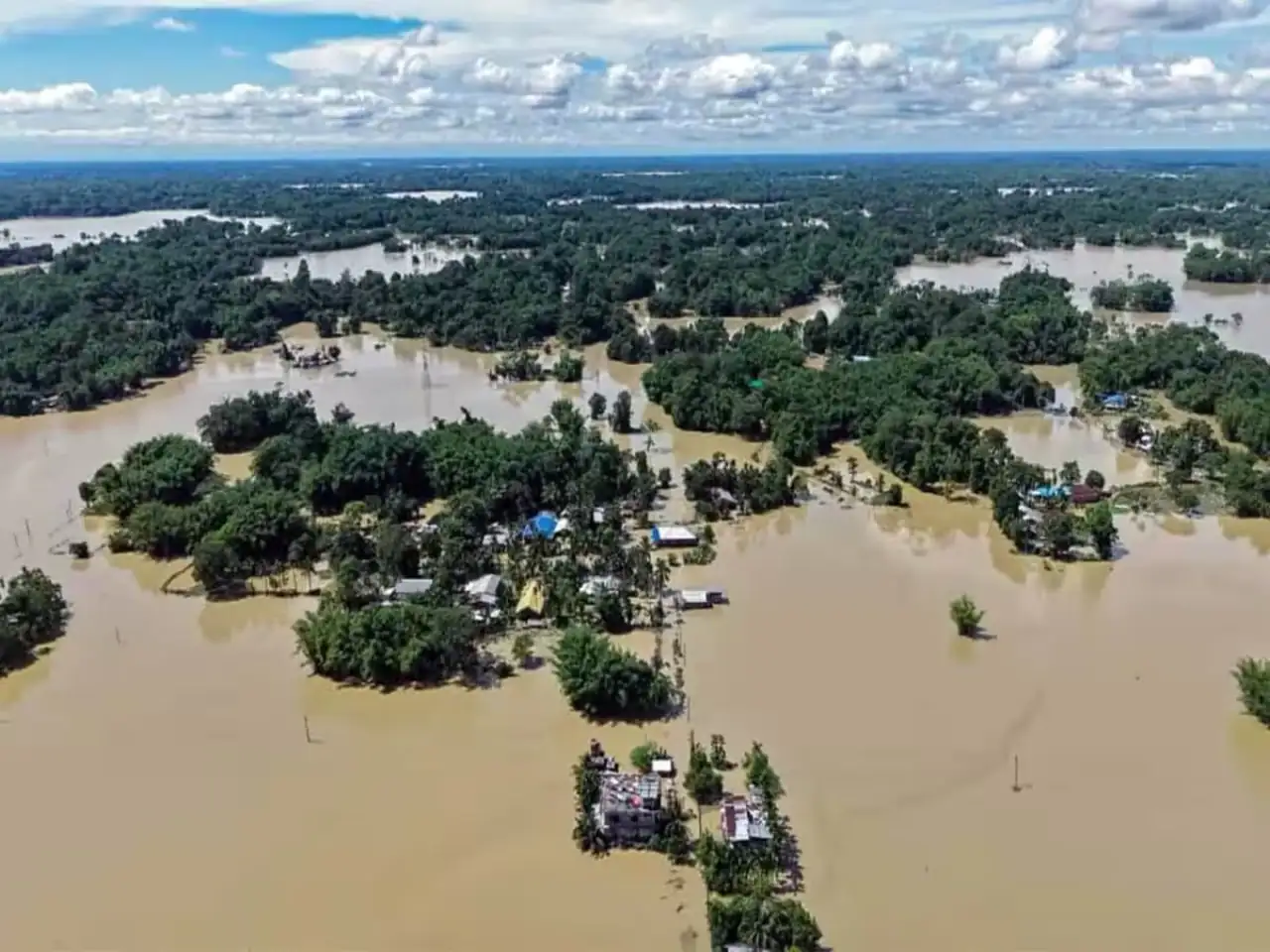
Devastating monsoon floods continue to batter Assam, claiming 66 lives and affecting more than 650,000 people across multiple districts. Swollen by heavy rains and upstream inflows, the Brahmaputra River and its tributaries have submerged homes, roads, and vast stretches of farmland, with Sivasagar emerging as the worst-hit area, followed by Charaideo and Jorhat.
According to the Assam State Disaster Management Authority (ASDMA), the latest death toll stood at 66 as of July 26, 2026, after additional fatalities were reported in recent days. Floodwaters have inundated hundreds of villages, damaged tens of thousands of hectares of cropland, reports cite figures around 25,000–35,000 hectares and disrupted connectivity across Upper Assam. Nearly 19,000 to 24,000 people are sheltering in hundreds of relief camps, while thousands more remain stranded or displaced. Rivers such as the Dikhou and Dhansiri continue to flow above danger levels in key locations.
The crisis has been described as “unprecedented” in scale by state officials, linked to intense rainfall in some areas far above normal and a cloudburst-like event in neighbouring Nagaland’s Mon district that triggered rapid flooding in districts including Sivasagar, Jorhat, and Charaideo. Livestock losses have been heavy, and agricultural damage threatens livelihoods for farming communities already facing the annual monsoon challenges that Assam endures.
Government Response and Central Support
Chief Minister Himanta Biswa Sarma has been overseeing large-scale rescue and relief operations, deploying state teams alongside national resources, including Indian Air Force helicopters for airdrops of essentials to hard to reach areas. The government has prioritised food, drinking water, healthcare, and shelter in relief camps, with special attention to women and children.
Prime Minister Narendra Modi spoke with Sarma on July 25, reviewing the situation and assuring full central support for relief, rehabilitation, and rebuilding. Sarma later conveyed that the Prime Minister expressed condolences over the loss of lives and property and affirmed that the disaster was being treated as a high priority.
Government Officials
“We will stand with every flood-affected family until this crisis is over. Relief camps must have adequate food, safe drinking water, healthcare and every essential facility. No family should be left without assistance.”
“The situation is extremely serious… Because of the cloudburst in Mon district of Nagaland and the heavy rainfall that followed, especially in Charaideo, Sivasagar and Jorhat, several areas have been flooded.”
— Chief Minister Himanta Biswa Sarma
“The Government of India will extend every possible support to aid our relief, rehabilitation and rebuilding efforts.”
— Prime Minister Narendra Modi as conveyed by CM Sarma
Sarma has also highlighted the use of Air Force choppers for targeted airdrops and ongoing efforts to ensure relief reaches every corner of the worst-affected districts.
Opposition parties, including Congress and Raijor Dal, have criticised the government’s preparedness and response. They have pointed to recurring floods despite past promises of a “flood-free Assam,” alleged delays in reaching some areas, and insufficient long-term measures against erosion and flooding. In the Assembly, heated exchanges occurred, with demands for detailed discussions on the crisis; one opposition MLA was briefly suspended amid protests over the handling of the issue. Critics have also raised concerns about embankment maintenance, sand mining, and overall flood management strategies.
Opposition Voices
Opposition leaders have accused the government of “gross and grave mismanagement,” arguing that promises of making Assam flood-free remain unfulfilled while people continue to suffer annual devastation. Congress and other parties have pressed for greater accountability, better preparedness, and immediate focus on unreached villages and sustained rehabilitation rather than short-term relief alone.
Victim’s Statements
While large-scale rescue and relief operations are underway, several residents in remote or heavily inundated pockets have spoken of delays or complete lack of assistance in the critical early days. Access difficulties due to submerged roads have left some families stranded longer than others.
Resident of Nazira Hulakatoni village
Speaking from the flooded area after waters rose sharply around 7 pm the previous night, a local resident said the family had moved upstairs for safety but had received no external help.
“No one has come yet… I am speaking from Nazira Hulakatoni village. Flooding started here around 7 PM last night. We all moved upstairs…”
Woman resident, Chandak village, Sivasagar
Her family’s home was completely destroyed, forcing them to live by the roadside.
She alleged that while political leaders visited the area with relief materials and assurances of financial assistance, government support has yet to reach her family.
Other residents in Sivasagar localities
Elderly residents and survivors in several affected parts of Sivasagar reported shortages of food and safe drinking water. Some said relief remained insufficient despite the scale of the disaster, while others claimed that several municipal wards were still awaiting timely rescue assistance. Large parts of Sivasagar town remained submerged, with many families still waiting for evacuation and emergency supplies.
Jatin Gogoi, 52-year-old farmer from Nazira
The rising waters swept away his bamboo-walled home and destroyed his livelihood.
“I lost all my cattle. My five-member family and I have nowhere to go, so we are taking shelter in a relative’s home,” he said over the phone.
These accounts underscore the challenges of reaching every marooned household in a disaster of this magnitude. While authorities continue to expand operations and airdrops, gaps in the initial response in certain pockets have left some families reliant on neighbours, relatives, or their own limited resources in the crucial first days.
As waters show early signs of receding in some areas, the focus is shifting toward assessing long-term damage, supporting farmers whose crops have been destroyed, and ensuring rehabilitation reaches those who were left waiting.
Assam’s vulnerability to monsoon flooding remains a persistent challenge, underscoring the need for both immediate aid and durable infrastructure solutions.
The state government, backed by central assistance, has reiterated its commitment to standing with affected families through the crisis. Relief efforts remain underway as communities begin the slow process of recovery.