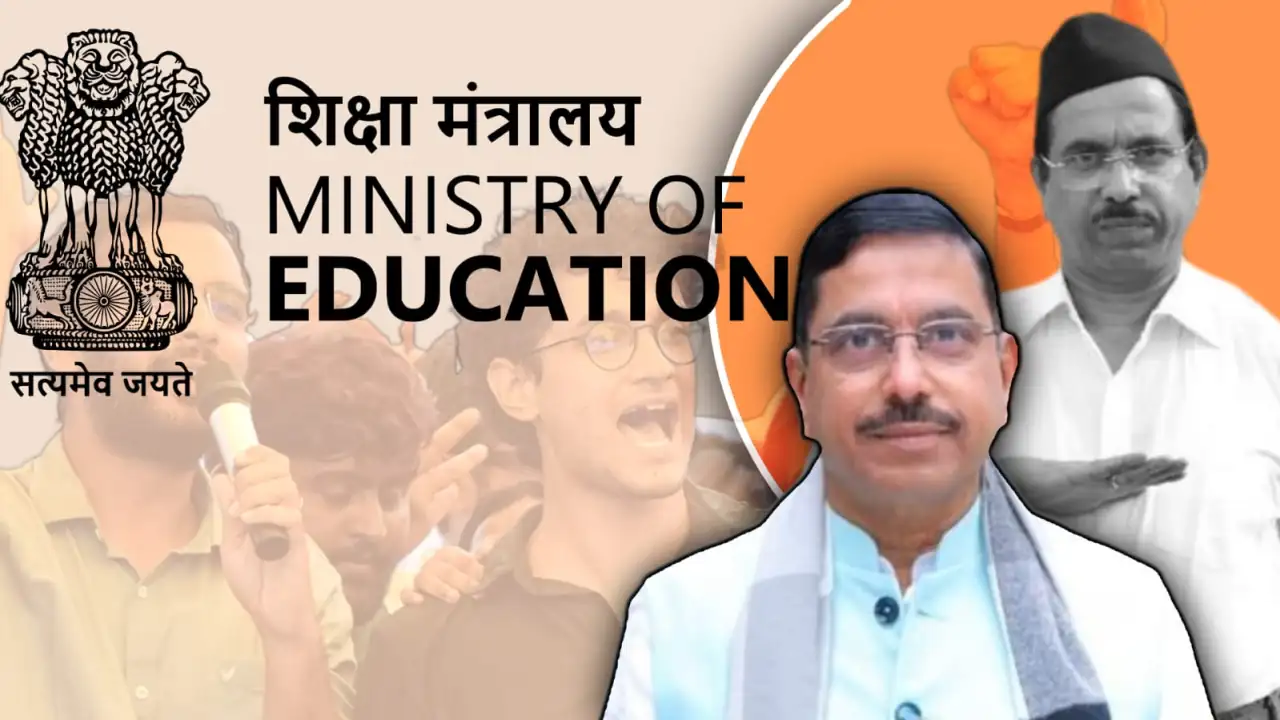
In late July 2026, Union Education Minister Dharmendra Pradhan resigned amid nationwide student-led protests over repeated NEET paper leaks and irregularities in the National Testing Agency. The protests, prominently associated with the youth-led Cockroach Janta Party movement that camped at sites including Jantar Mantar, forced a rare concession from the government. Hours later, the President assigned additional charge of the Ministry of Education to Pralhad Joshi, the Cabinet Minister already handling Consumer Affairs, Food and Public Distribution, and New and Renewable Energy.
The resignation was widely hailed as a student victory. Yet Joshi’s long record as a lifelong RSS associate and his past positions on communal issues have prompted a sharper question: Did the students secure meaningful change in the direction of India’s education system, or did the government simply replace one loyalist with another ideologically aligned figure?
Joshi’s Deep Roots in the Sangh Parivar
Pralhad Joshi has been linked to the Rashtriya Swayamsevak Sangh (RSS) since childhood in Hubballi, Karnataka. He attended shakhas and advanced training camps during his formative years. After years as a full-time grassroots RSS worker through the 1980s and early 1990s, he moved into the BJP’s organisational structure in 1995. Wikipedia and contemporary profiles describe him as a member of the RSS from a young age who attended its training camps; he first gained public notice through the RSS-backed campaign to hoist the national flag at Hubli’s Idgah Maidan in the early 1990s.
He does not currently hold a formal administrative post inside the RSS hierarchy. Instead, observers describe him as a trusted ideological bridge between the Sangh leadership and the Union Cabinet, ensuring policy alignment, particularly relevant now that education falls under his additional charge. Like Prime Minister Narendra Modi and many senior BJP figures, Joshi’s political identity is inseparable from the broader Sangh Parivar network that champions a Hindu nationalist vision of the nation.
The Hijab Controversy and Communal Image
Joshi’s public profile includes sharp interventions on the Karnataka hijab row. He welcomed the Karnataka High Court’s 2022 verdict upholding the ban on hijabs in educational institutions, stating that students’ primary duty is to study and that the court’s order should be accepted to maintain peace. More recently, in 2026, he criticised the Congress-ruled Karnataka government for withdrawing the hijab ban, calling it disrespect to the judicial process while the matter remained sub judice.
Earlier episodes have reinforced perceptions of an anti-Muslim tilt. In 2018, an FIR was registered against him after remarks comparing a Hubballi locality (Sadar Sofa) to Pakistan and alleging that mosques illegally stored weapons—comments that sparked protests by Muslim groups. These episodes, combined with his RSS background, have made him a polarising figure for critics who argue that India’s education ministry requires a technocratic, inclusive steward rather than a political loyalist with a history of communal flashpoints.
Student Victory or Continuity?
Supporters of the government frame Joshi’s appointment as administrative continuity and a sign that the system responded to public pressure without disrupting governance. Opposition voices and student activists see something different: a refusal to address the deeper demand for accountability, transparency in exam systems, and an education policy free from ideological capture.
“The struggle and determination shown by the youth over 28 consecutive days at Jantar Mantar is truly commendable. But replacing one minister with another from the same ideological ecosystem does not automatically fix the structural failures that produced repeated paper leaks.”
— Opposition leaders reacting to Pradhan’s resignation and the subsequent appointment
Cockroach Janta Party spokespersons struck a cautious note, acknowledging that their core demand for Pradhan’s removal had been met while insisting the real test lies ahead:
“Our concern and demand was met… the next education minister knows that the youth are watching and will demand answers. Curb paper leaks, implement the five-point charter, and work in the interest of students.”
— Cockroach Janta Party Chief Spokesperson Saurav Das.
Critics go further, arguing that the appointment signals the BJP’s unwillingness to listen to the substantive aspirations of India’s youth. They contend that a lifelong RSS swayamsevak with a record of polarising statements is unlikely to prioritise merit-based, secular, and corruption-free examination systems over cultural and ideological priorities long associated with the Sangh.
What the Data and Record Suggest
Joshi brings parliamentary experience six-time MP from Dharwad and administrative tenure in other ministries. He has no direct prior charge of education policy at the national level. The Ministry of Education inherits a crisis of credibility after successive entrance-exam controversies. Whether Joshi can restore trust will depend less on his organisational loyalty and more on concrete reforms: independent oversight of testing agencies, swift prosecution of leak networks, and insulation of curriculum and examinations from partisan influence.
For many student protesters, the resignation itself was a hard-won breakthrough, the first major concession extracted by sustained youth mobilisation in recent years. Yet the choice of successor has left a lingering doubt. A change of face is not automatically a change of direction. India’s young people, who forced a minister out through collective pressure, now face the practical question of whether the new incumbent will treat their future as a priority or as another arena for ideological consolidation.
The coming months—how the government handles the next round of entrance exams, responds to the CJP’s charter, and manages the National Testing Agency will provide the real answer to whether students truly won.
However, one question remains: has any real change occurred in India’s education system after the student-led protests? Many observers argue that Joshi’s political and ideological track record does not align with the responsibilities of leading the Education Ministry, raising doubts about whether his appointment will bring meaningful reforms.