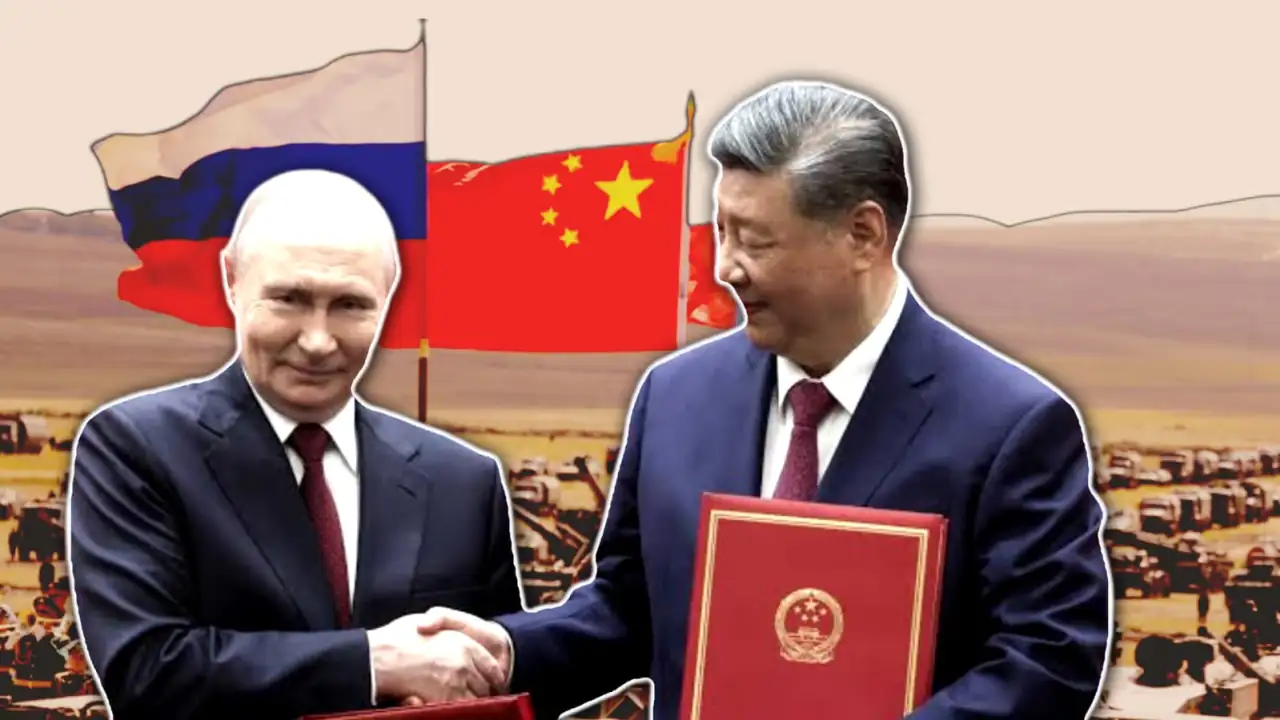
China is drawing battlefield lessons and advanced military technology from its partnership with Russia amid the war in Ukraine, raising Western concerns that these gains could enhance Beijing’s capabilities in a potential conflict over Taiwan.
The flow of support has long run primarily one way. China has supplied Russia with dual-use components like engines, electronics, and other goods that end up in drones and weapons systems helping sustain Moscow’s attritional campaign. Western governments have repeatedly criticized this assistance. More recently, attention has shifted to what China is receiving in return: training, intelligence, and technology that could sharpen the People’s Liberation Army (PLA).
According to reporting in The Economist, Chinese military personnel have trained since 2024 at a Russian facility near Volgograd in drone operations and urban combat. China, already the world’s largest producer of drones, is studying practical tactics refined under combat conditions. Officials note particular interest in the Russian navy’s experience- often difficult, later improved countering Ukrainian naval drones in the Black Sea. These insights matter for any future amphibious or littoral operations.
Beyond tactics, Western officials assess that Russia is sharing technologies it had previously guarded more carefully. These include advances relevant to air and missile defense systems and assistance in reducing the acoustic signature of nuclear-powered submarines, making them harder to detect. Intelligence sharing is also reported. Collectively, these transfers could address longstanding PLA weaknesses in areas such as undersea stealth, integrated air defenses, and the mass employment of unmanned systems.
The strategic implication that most worries American and European officials is Taiwan. Russia is not expected to intervene directly in any Taiwan contingency, just as China has avoided direct combat involvement in Ukraine. The partnership remains transactional rather than a full military alliance. Even so, real-world combat data, refined tactics, and selective technology transfers could accelerate Chinese military modernization and improve readiness for high-intensity operations across the Taiwan Strait.
This dynamic sits within a broader pattern of Sino-Russian defense cooperation that has deepened since the full-scale invasion of Ukraine. Joint exercises, officer exchanges, and industrial collaboration have expanded. The war has provided an unparalleled laboratory: Russia tests systems and concepts under fire, while China observes, trains, and selectively absorbs what proves useful. For Beijing, the arrangement yields practical knowledge without the costs and risks of direct participation. For Moscow, Chinese industrial support helps offset Western sanctions and sustain production.
Western responses have so far focused more on restricting China’s dual-use exports to Russia than on disrupting the reverse flow of expertise. The difficulty lies in verification and attribution. Training can occur quietly, technology transfers can be packaged as commercial or dual-use deals; intelligence sharing is inherently opaque. Officials therefore rely on intelligence assessments rather than open-source confirmation for many of the most sensitive claims.
The longer-term effect remains uncertain. Combat experience is context-specific; lessons from the Ukrainian plains and Black Sea do not map perfectly onto the geography, distances, and maritime environment of the Taiwan Strait. Chinese planners must still solve their own logistical, command-and-control, and amphibious challenges. Yet the combination of refined unmanned tactics, quieter submarines, improved air defenses, and better intelligence could narrow capability gaps that the United States and its partners have counted on to deter aggression.
In short, the war in Ukraine is not only reshaping Europe’s security landscape. Through the China-Russia partnership, it is also feeding practical military knowledge eastward, knowledge that Western governments fear could alter the military balance across the Taiwan Strait in the years ahead.