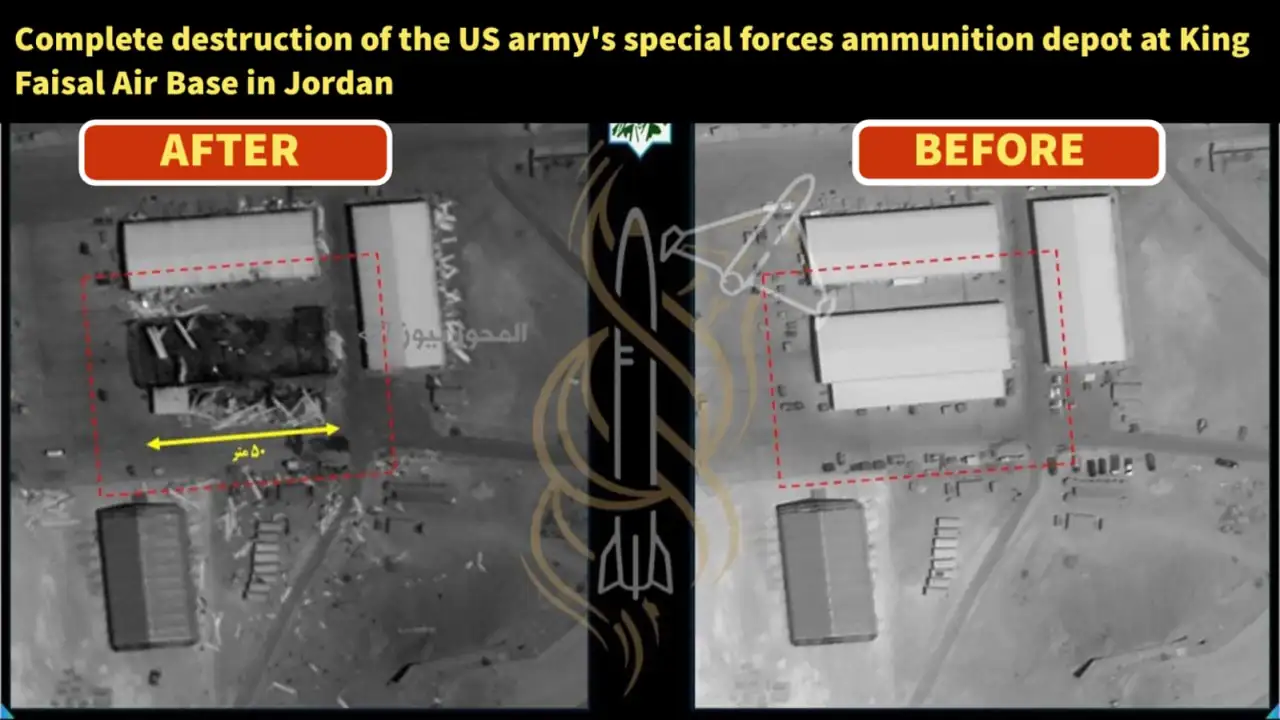
Iranian media claims of the complete destruction of a US Army Special Forces ammunition depot at King Faisal Air Base in Jordan, based on satellite imagery released around July 25, 2026, following Iranian missile and drone strikes reported around July 22–24.
King Faisal Air Base, near Al-Jafr in southern Jordan, is a Royal Jordanian Air Force facility that has hosted U.S. personnel, including special operations forces, for training, joint exercises, and regional support roles over the years. It has a history of hosting U.S. forces as part of America’s strategy to maintain regional dominance.
Iran’s Islamic Revolutionary Guard Corps (IRGC) claimed attacks on King Faisal and Prince Hassan air bases as part of broader retaliatory operations amid the ongoing regional conflict. Iranian state media and aligned outlets later published before-and-after high-resolution satellite images purportedly showing a large storage area reduced to rubble, identifying it as a US Army Special Operations Forces ammunition depot. Social media posts and outlets amplified the “full destruction” narrative, with coordinates and visual comparisons circulating widely.
Independent or Western confirmation of the specific function of the site as a special forces ammo depot, or of total destruction, is lacking. The Pentagon and Jordanian authorities have not publicly verified the precise role of the facility or the full extent of the damage in available reporting. Other claims around the same period involved damage to hangars, aircraft including F-15-related facilities, drones, and helicopters at bases in Jordan, with some US casualties reported in related strikes, but details remain contested or incomplete. Jordan reported intercepting some incoming missiles and drones.
Satellite imagery from commercial or other sources has been cited as showing smoke, structural damage, or impacted areas at the base, lending visual weight to reports of hits, though interpretation of exact targets and outcomes varies by source.
Cost of Destruction
No official US figures exist for the value of any specific ammunition stockpile at King Faisal, as such details are typically classified and the claims themselves are unverified by American or Jordanian authorities. Estimates are therefore speculative and based on broader public data about US conventional ammunition holdings.
The US Department of Defense has maintained conventional ammunition stockpiles valued in the tens of billions of dollars overall, historically cited around $70 billion in contingency stocks, with surplus or excess portions previously valued in the $16 billion range.
Major US depots (such as Hawthorne Army Depot, the largest) involve enormous storage capacity and multi-billion-dollar long-term operations/maintenance contracts. A forward-deployed special operations ammo storage site would be far smaller likely holding specialized small-arms, explosives, and other munitions for training and contingency use rather than theater-level artillery stocks.
Individual artillery rounds or specialized munitions can cost thousands of dollars each; small-arms ammunition is cheaper per unit but can accumulate significant value in volume. Destroying even a modest forward depot could represent tens of millions of dollars in materiel, plus infrastructure repair, safety remediation of unexploded ordnance or secondary explosions, and replacement/logistics costs. Broader economic and operational impacts would add further expense.
Without inventory specifics or official damage assessments, precise costing is impossible. Historical data on demilitarization and storage underscore that ammunition represents substantial sunk and replacement costs even before combat losses.
The base has long featured in US-Jordanian military cooperation. Claims of this nature fit a pattern of Iranian information operations highlighting successful long-range strikes and US vulnerabilities, while US and partner statements have often focused on interceptions, limited damage, or broader conflict dynamics. As of the latest available reporting late July 2026, the situation remains part of a fluid regional exchange of strikes, with pauses and diplomatic signals also noted in some accounts.
Verification of battlefield claims in active conflict zones is inherently difficult; satellite imagery provides useful open-source indicators but requires careful analysis of resolution, timing, and context. Official US or Jordanian releases, if and when they appear, would provide the most authoritative accounting of damage and costs.