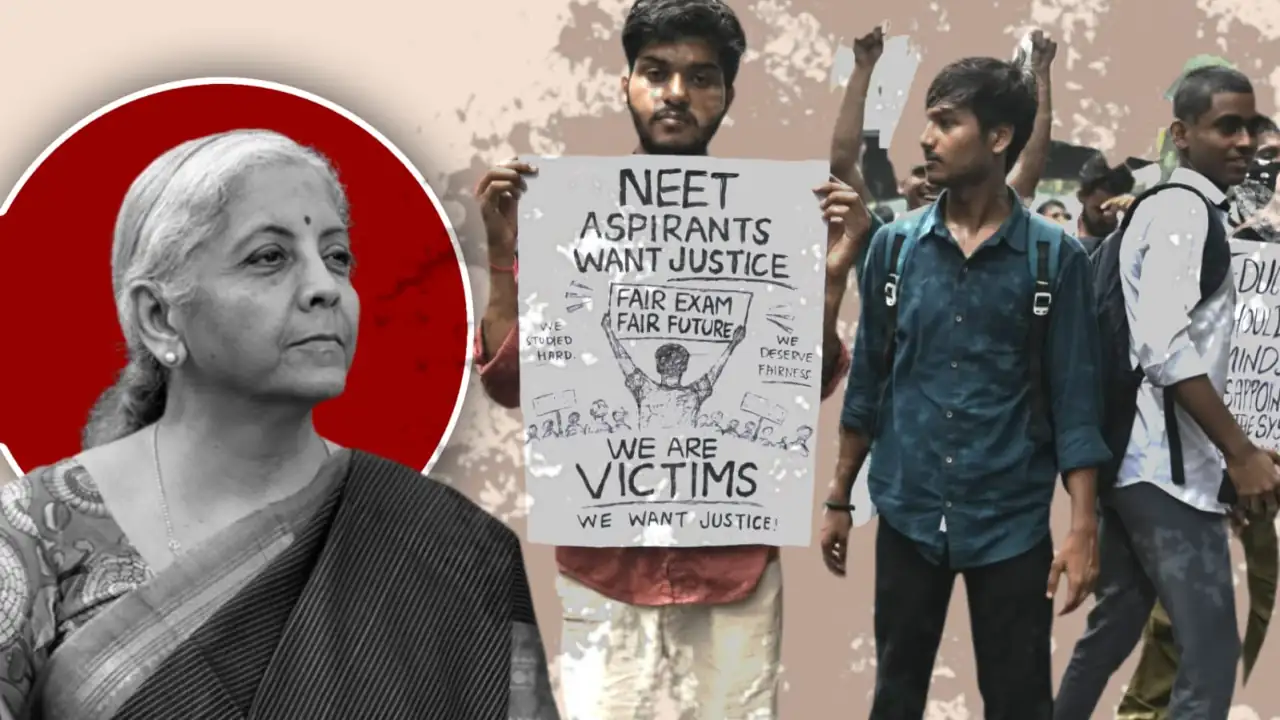
Finance Minister Nirmala Sitharaman’s remarks on the NEET-UG paper leak controversy have triggered sharp backlash, with critics accusing her of being tone-deaf to the human cost of the scandal including multiple student suicides even as the government highlights arrests, a re-examination, and plans for fast-track courts.
The comments came amid ongoing nationwide protests, primarily led by student groups including the Cockroach Janta Party (CJP), demanding accountability for alleged irregularities in the National Eligibility cum Entrance Test (NEET-UG) 2026 and the resignation of Union Education Minister Dharmendra Pradhan.
Allegations of a paper leak linked in reports to Sikar, Rajasthan, around early May 2026 led the National Testing Agency (NTA) to cancel the original exam. A re-test was held on June 21. The episode disrupted the plans of over 22 lakh candidates and intensified scrutiny of repeated examination security failures in India.
Reports indicate at least 20 NEET aspirants died by suicide in the roughly 37 days between the cancellation announcement and the re-test. Cases were reported from states including Rajasthan, Uttar Pradesh, Madhya Pradesh, Tamil Nadu, Gujarat, and others. Families and protesters have linked the deaths to the intense pressure, uncertainty, and sense of dashed years of preparation.
Protests have continued, with marches to Parliament met by police action in some instances, injuries on both sides, and political sparring in and outside Parliament.
Sitharaman’s Statements
In an interview addressing the protests, Finance Minister Nirmala Sitharaman defended the Centre’s response. She noted that arrests of those involved in leaking, buying, and selling papers had been made, the re-exam conducted promptly, results declared, and that Prime Minister Narendra Modi had announced fast-track courts for paper-leak cases to ensure swift justice.
She also highlighted what she described as resilience among some students:
“There are young people who are coming out and saying, ‘Yes, first it hurt me when the paper leaks happened. But later I took advantage of that and prepared even more, and my performance has improved.’ So, there are young people who have taken this challenge and come out with bright colours. With all this, the government is responding, the PM is responding.”
Sitharaman added that the government’s timely actions — arrests, re-exams, and results had enabled students to move forward with higher education plans. She criticised the Opposition for mounting a “tirade,” arguing that such criticism would be understandable only if the government had failed to respond sensitively to an issue affecting young people.
She further stated that those who “violated the sacredness” of examinations by leaking, buying, or selling papers would face punishment, pointing to prior arrests and the new fast-track court mechanism.
Backlash and Critical Voices
The remarks drew immediate criticism for appearing to frame the extra preparation time from the delay as a net positive, while downplaying the distress, disruption, and deaths.
CJP spokesperson Ashutosh Ranka responded sharply:
“By this logic every paper in this country should get leaked.”
TMC MP Mahua Moitra questioned the framing:
“Did @nsitharaman just say ‘Due to the paper leak, the children got even more time to study so that they could perform better’? Honestly this entire Cabinet should resign.”
Shiv Sena (UBT) MP Priyanka Chaturvedi was sarcastic:
“How to take advantage of reexamination on account of leaked paper. Very succinct. Students please listen and stop protesting.”
Opposition leaders and protesters accused the comments of trivialising systemic failures in exam integrity and the mental-health crisis facing aspirants under high-stakes testing pressure. Critics argued that celebrating individual score improvements ignores the broader cost borne by families who lost children and by the vast majority of candidates whose preparation and mental well-being were upended.
Education experts and mental-health advocates have long pointed to the extreme competitiveness of NEET, repeated irregularities, and inadequate support systems as contributors to student distress. The current episode has amplified calls for deeper reforms to the NTA, stronger safeguards against leaks, and greater attention to aspirant mental health — beyond political point-scoring.
The government maintains it has acted decisively: arrests were made, the re-exam held, results processed, 47 NTA personnel reportedly sacked, and fast-track courts announced. Talks with CJP representatives have been held, with reports of in-principle agreement on some demands such as compensation for families of deceased students and withdrawal of certain FIRs, though the core demand for Pradhan’s resignation remains unresolved. Education Minister Pradhan has previously acknowledged systemic lapses (“protectors turned predators”) and expressed personal accountability regarding student suicides while accusing the Opposition of politicising the tragedy.
The episode underscores persistent challenges in India’s high-stakes examination ecosystem. While some students may have used the forced delay to improve scores, the dominant public narrative centres on lost trust, preventable human tragedies, and the need for structural fixes that prioritise both integrity and the well-being of young aspirants.