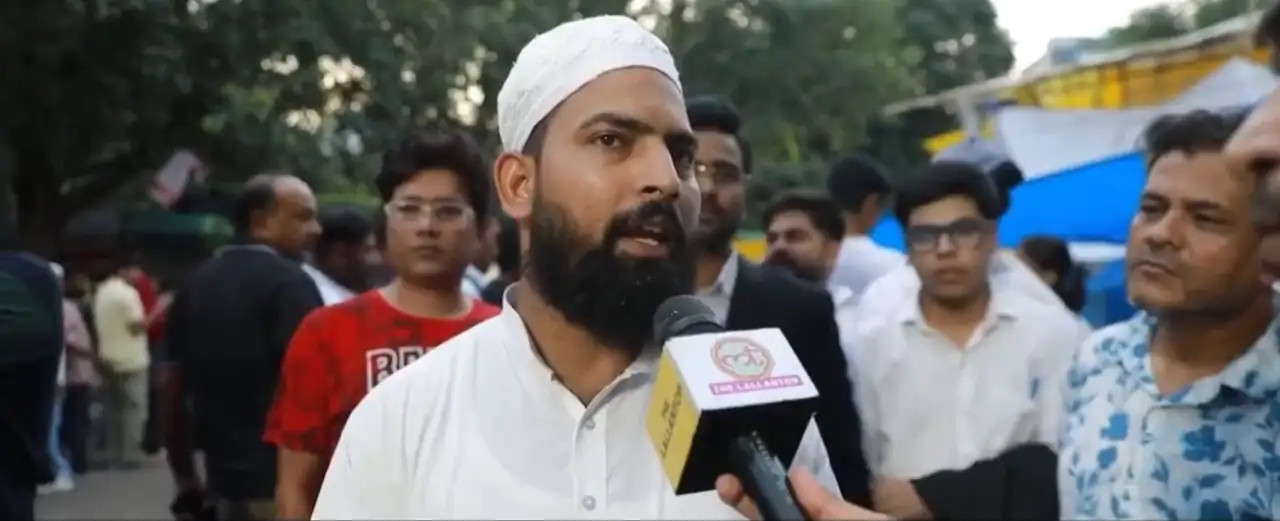
Student leaders and supporters report that his father and minor brother were detained, identity and banking documents including passbooks and Aadhaar cards were seized, and police also visited his sister’s residence in Meerut, detaining her father-in-law and devar (brother-in-law). They describe repeated threats pressuring Junaid to leave the Delhi protest site or face continued family pressure. Police have not publicly confirmed or detailed the actions.
The CJP protest, which began in mid-to-late June 2026, centers on demands for accountability over repeated examination paper leaks notably NEET-UG and the resignation of Union Education Minister Dharmendra Pradhan. Protesters, many young and self-described “cockroaches” in a satirical reference, have maintained a sustained presence at the site. Junaid became a visible figure by arranging and handing out food packets, water bottles, and other essentials day and night, often drawing community support and delivery orders from across the country. Earlier coverage portrayed his role as quiet logistical solidarity rather than political leadership.
Supporters and student leaders, including Danish Ali, frame the reported family detentions and document seizures as state intimidation aimed at forcing Junaid off the protest ground. They argue the action targets ordinary humanitarian help rather than any substantiated criminality. Posts and statements circulating among protesters emphasize that providing free sustenance to people exercising their right to assemble should not invite raids on relatives, including minors, or the taking of personal documents.
Critics specifically highlight a striking pattern: police reportedly detained Junaid’s family members including his father, a minor brother, and relatives at his sister’s home, while leaving Junaid himself free at the protest site in Delhi. According to these critics, the authorities are deliberately using his relatives as leverage. By holding family members and seizing their identity and banking documents, they aim to exert indirect pressure on Junaid, compelling him to abandon the demonstration and return home. This approach, they contend, allows the police to disrupt the volunteer’s support work without the visibility or potential backlash of directly detaining a person actively aiding protesters in the national capital.
A man who distributes food and water entirely free to protesters—how can that appear as a crime under the law?
Distributing food and water without charge, even at a protest site, is not inherently a criminal offence under ordinary Indian law. Charitable or voluntary supply of essentials does not, by itself, violate the Indian Penal Code, the Code of Criminal Procedure, or laws governing public assembly when the activity remains peaceful and non-coercive. Free distribution of food and water is common in religious, social, and political gatherings across India and is generally treated as private or community charity.
Possible legal hooks sometimes invoked in protest-related cases include:
▪️Questions about the source of funds (if authorities suspect illegal financing, foreign contributions without FCRA compliance, or money-laundering).
▪️Allegations of obstructing public order, unlawful assembly facilitation, or violation of specific prohibitory orders under Section 144 CrPC (if any were in force and breached).
▪️Recovery of documents or inquiries under general investigative powers if a broader probe is claimed.
None of these, however, automatically criminalise the act of handing out free food and water. Detaining family members, including a minor, seizing identity and banking papers, and linking the action explicitly to the volunteer’s presence at a protest site raise separate questions of proportionality, due process, and potential misuse of police power. Indian courts have repeatedly stressed that family members cannot be treated as leverage and that investigative actions must rest on specific, disclosed grounds rather than collective pressure.
The continued absence of any official statement from Uttar Pradesh Police explaining why the family members were detained, while Junaid remains free further fuels concerns about the credibility of the process. Without a publicly disclosed FIR, charge-sheet, or clear legal justification, the reported detentions appear to critics as arbitrary pressure tactics rather than transparent law enforcement. This silence, they argue, undermines public confidence in the rule of law. If genuine grounds for detention exist, authorities should state them openly, if none are forthcoming, the actions risk being seen as Unlawful pressure.
Junaid’s reported account of the events, as conveyed through student leaders and media conversations, has been summarised in circulating statements.
One representative version attributed to him and amplified by supporters reads:
“The UP Police came to my home, took my father and my minor brother, seized our passbooks and Aadhaar cards, and went to my sister’s house in Meerut and detained her in-laws. They keep telling me to leave Delhi and return, otherwise they will not release my father. I have only been giving food and water to the students and people who are sitting here for justice. What crime is that?”
As of the latest available reports, the detentions and any related inquiries remain unconfirmed by official police channels. The episode has intensified debate over the treatment of volunteers who support peaceful protesters by distributing free food and water.
According to the allegations, police detained the volunteer’s family members not the volunteer himself and reportedly pressured them to persuade him to leave the protest. These claims have further fueled concerns about the protection of peaceful assembly, humanitarian assistance, and the limits of police action.
Independent reporting and, if necessary, judicial review will be required to establish the facts and determine whether the reported actions had a lawful basis.