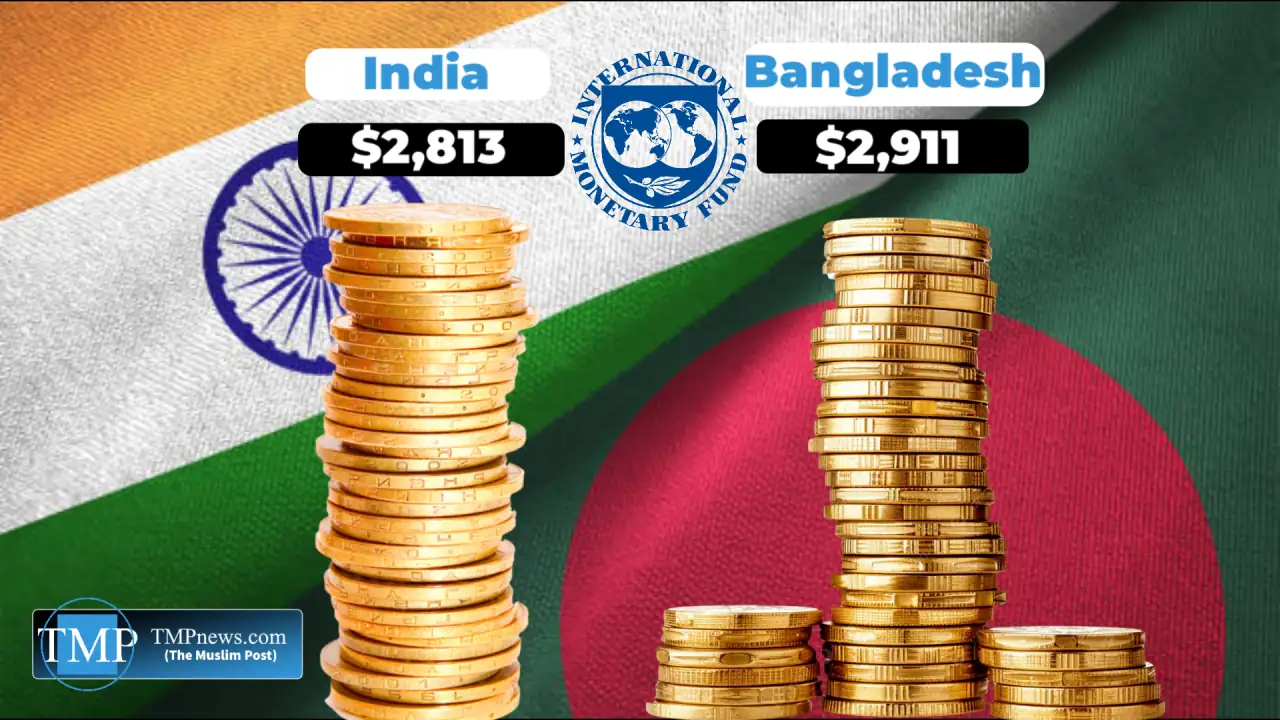
According to the International Monetary Fund’s World Economic Outlook released in April 2026, Bangladesh is projected to marginally surpass India in nominal GDP per capita in 2026. Bangladesh’s figure stands at $2,911, compared to India’s $2,812, a difference of just $99 per person.
For Bangladesh, this statistical milestone represents a moment of pride. A much smaller nation has briefly “beaten” a giant neighbor in one visible metric. For India, however, it serves as a sobering reminder of untapped potential and the hurdles that prevent it from realizing its ambition to compete with global powers like the United States and China.
Scale Makes Direct Comparison Uneven
India is approximately 22 times larger than Bangladesh in land area (3.287 million sq km vs. 148,460 sq km). Its population is roughly 8 times bigger, with India projected to have around 1.45–1.48 billion people in 2026 compared to Bangladesh’s approximately 170–178 million.
Bangladesh already has a population larger than Russia’s (around 143 million), despite Russia being over 100 times larger in territory. This highlights Bangladesh’s success in managing extreme population density and converting a large, young workforce into export-driven growth, particularly in the ready-made garments sector.
India, on the other hand, carries the burden and opportunity of a demographic scale comparable to China’s. Lifting living standards for 1.4+ billion people across a vast and diverse country demands far greater coordination in infrastructure, education, job creation, and governance.
India’s total GDP remains overwhelmingly larger, projected at around $4.1 trillion in 2026 versus Bangladesh’s roughly $510 billion. In purchasing power parity (PPP) terms, India maintains a comfortable lead (approximately $12,800 vs. Bangladesh’s $10,950). India’s real GDP growth is also stronger, forecasted at 6.5% compared to Bangladesh’s 4.7%. The IMF expects India to regain the per capita lead in 2027 ($3,074 vs. $3,048) and hold it thereafter.
A “Victory” for Bangladesh, a Wake-Up Call for India
Bangladesh deserves credit for its focused execution. Its ability to match and briefly overtake a much larger neighbor in per capita terms demonstrates effective workforce utilization in a compact economy. For a smaller country, this is a notable achievement against a well-known regional giant.
For India, even temporarily falling behind is a matter of concern given its enormous potential. A nation of India’s size and resources should not only overtake smaller neighbors comfortably but also position itself to challenge far larger economies like the US and China in the coming decades. The fact that India struggles to maintain a consistent lead over a country one-eighth its population size raises questions about the pace of its development.
A key factor often cited is India’s domestic politics. Political parties frequently resort to communal slogans and identity-based mobilization to polarize voters, creating periodic unrest that distracts from long-term governance Failures. This approach can hinder consensus on critical reforms in education, infrastructure, manufacturing, and skill development.
India’s electoral calendar compounds the issue. With elections at national, state, and local levels occurring frequently, campaign mode often begins six months or more in advance. Development agendas frequently take a backseat to short-term vote-bank strategies, slowing the kind of sustained policy focus needed for rapid, inclusive growth.
Workforce Challenges for Both Nations
Both countries possess large youthful workforces, but harnessing them productively remains difficult.
▪️Bangladesh must address its own rapidly growing population and risks of over-reliance on a few export sectors, while preparing for future climate and energy pressures.
▪️India’s challenge is on a vastly larger scale: creating high-quality jobs for hundreds of millions while managing diversity across regions, languages, and communities.
The real test for India is not merely regaining a marginal per capita edge over Bangladesh next year, that would itself feel like a limited achievement given the massive disparity in size and population. The deeper question is how quickly India can accelerate reforms to close the gap with advanced economies.
The Path Forward
Citizens in both countries ultimately want better jobs, education, healthcare, and living standards. For Bangladesh, sustaining momentum while tackling population pressures will be crucial. For India, the priority should be shifting political energy toward development and human capital rather than divisive mobilization.
Pressuring political leaders to prioritize long-term nation-building over short-term electoral gains is essential. Focusing on quality education, skill development, infrastructure, and economic reforms, instead of communal polarization for votes, could help India unlock its true potential.
The IMF projection is a temporary statistical snapshot influenced by exchange rates and other short-term factors. It should not define rivalry but serve as motivation. Bangladesh can celebrate its compact success. India must treat it as a prompt to aim higher: not just matching or beating a much smaller neighbor, but building the productivity and governance needed to compete on the global stage with America and China.
Sustainable progress for both nations will depend less on annual IMF rankings and more on pragmatic policies that deliver broad-based growth and opportunity for their people.