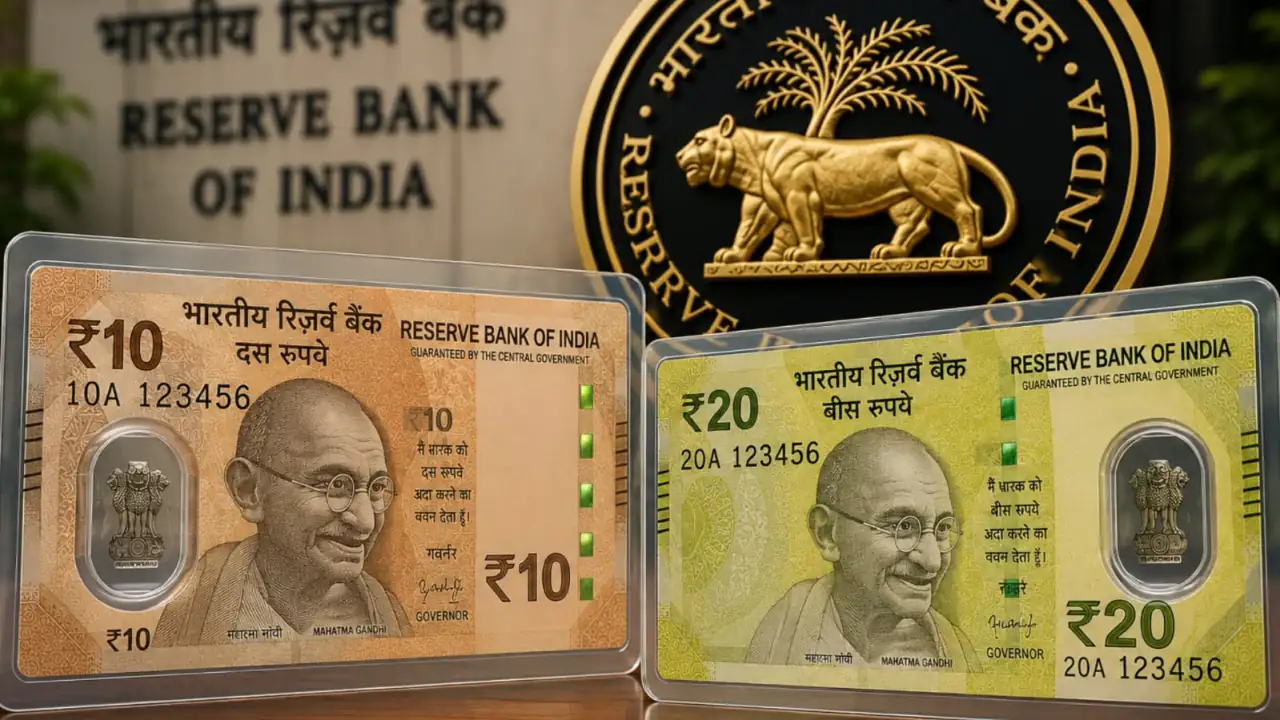
The Central Government has approved the Reserve Bank of India’s (RBI) proposal to introduce polymer (plastic) banknotes in the ₹10 and ₹20 denominations for field trials. The decision was conveyed in Parliament by Minister of State for Finance Pankaj Chaudhary in a written reply to the Lok Sabha on Monday.
Under the approved plan, the RBI will print and issue 1 billion pieces each of ₹10 and ₹20 polymer banknotes specifically for these trials. The polymer notes will circulate alongside existing paper-substrate notes. There is no proposal to replace all paper currency with polymer notes.
Polymer banknotes, made from a durable synthetic polymer (typically biaxially oriented polypropylene), are known internationally for lasting significantly longer than traditional paper notes. They are more resistant to wear, water, and soiling—advantages particularly relevant for lower-denomination notes that see heavy everyday use in India. Regular issuance of polymer notes in these two denominations will begin only after the successful completion of the field trials.
The RBI had submitted the proposal, with the recommendation of its Central Board, under Section 25 of the Reserve Bank of India Act, 1934. The trials will help assess the notes’ performance under Indian conditions, including durability, security features, public acceptance, and overall cost-effectiveness. India had previously explored limited polymer note trials more than a decade ago, but the idea was not scaled up at the time due to technological and other challenges. Globally, more than 60 countries already use polymer banknotes, with Australia pioneering the technology in 1988.
The move comes amid rising costs of printing and replacing soiled paper currency. The government and RBI have clarified that banknotes and digital payment systems remain complementary tools for the public.
Official Statements as conveyed in Parliament
“The RBI, with the recommendation of its Central Board, had sent a proposal to the government in terms of Section 25 of the Reserve Bank of India Act, 1934, for the introduction of 1 billion pieces each of ₹10 and ₹20 polymer banknotes for field trials and for the regular issuance of polymer banknotes in these two denominations after the successful completion of field trials. The proposal has been approved by the government.”
— Minister of State for Finance Pankaj Chaudhary
“The polymer banknotes will be issued along with paper-substrate banknotes… there is no proposal to replace paper currency with polymer-substrate banknotes.”
— Minister of State for Finance Pankaj Chaudhary
“RBI had informed that, as per international studies, the life span of polymer banknotes is significantly higher than that of paper banknotes. The introduction of polymer banknotes is currently in a preliminary phase…”
— Minister of State for Finance Pankaj Chaudhary
The field trials mark an important step in evaluating whether polymer technology can improve the efficiency and longevity of India’s currency system while keeping paper notes firmly in circulation. Further details on the timeline and locations of the trials are expected from the RBI in due course.