President Donald Trump’s net approval rating has fallen to -24, according to The Economist/YouGov poll tracker updated on May 29, 2026, the lowest point since the survey began tracking his approval in 2016 (and across both terms).
The latest weekly data shows 34% of Americans approve of Trump’s job performance, while 58% disapprove, with 6% unsure. This marks a 1.9-point drop from the previous week and represents a new nadir, surpassing previous lows from his first term and earlier in his second.
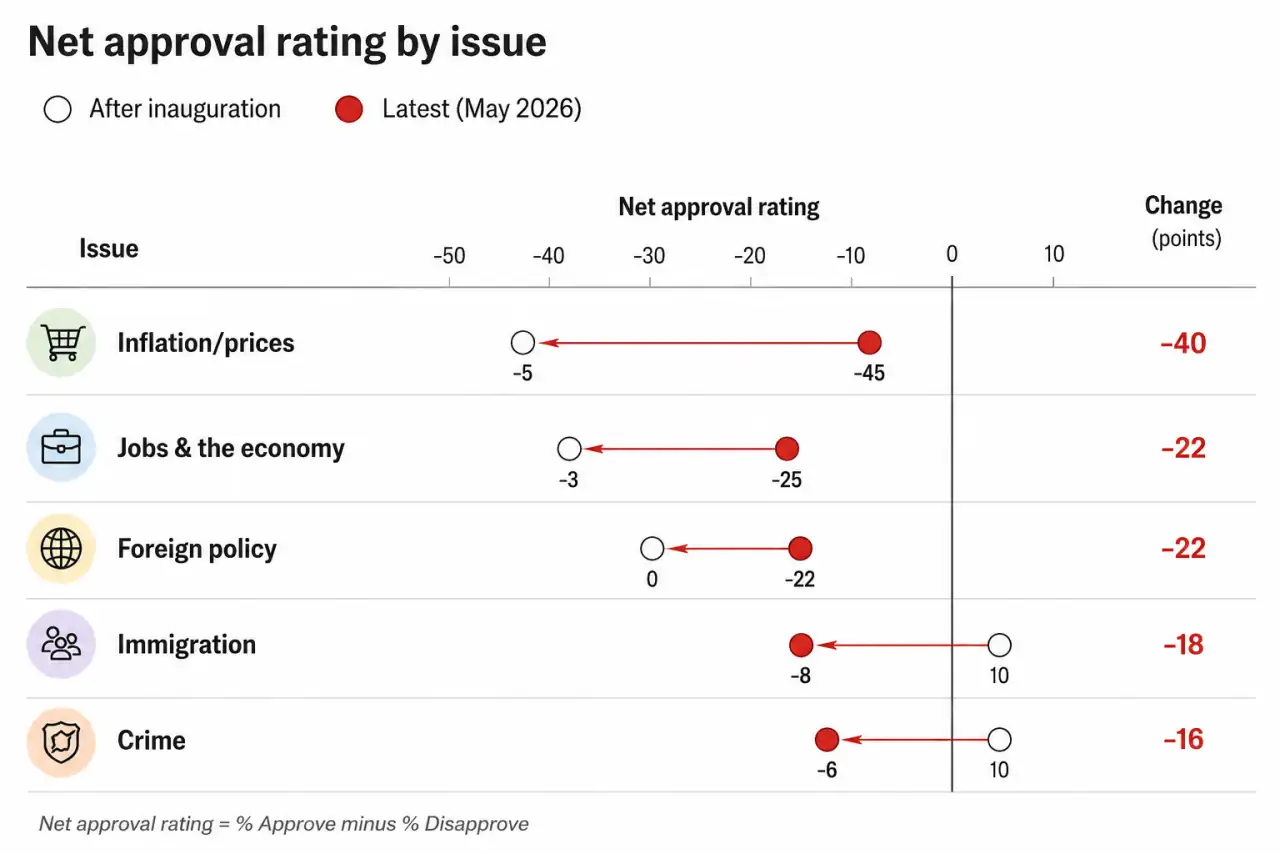
The sharp drop is fueled primarily by widespread dissatisfaction with the economy. Trump’s net approval on inflation stands at a dismal -43, as Americans grapple with persistent price pressures.
Rising gas prices have emerged as a particularly potent flashpoint. The ongoing U.S. involvement in the Iran War has disrupted global oil supplies, pushing average U.S. gas prices above $4 per gallon in many regions, levels not seen since 2022. Many voters directly attribute these increases to the conflict, with polls showing significant majorities blaming the administration’s foreign policy decisions.
Economic unease has extended beyond fuel costs. Broader concerns about inflation, supply chain disruptions, and market volatility linked to the Middle East conflict have eroded confidence even among some traditional Republican supporters. Recent surveys indicate that Republican approval of Trump’s economic handling has softened amid these pressures.
Trump’s net approval on foreign policy has also deteriorated to around -20, with the Iran War cited as a key factor. While the administration has defended military actions as necessary to counter Iranian threats and protect U.S. interests, public sentiment has turned skeptical.
Multiple polls show a majority of Americans, including a notable minority of Republicans, disapproving of the handling of the conflict. Concerns range from the war’s duration and costs to its domestic economic repercussions.
This slump comes roughly five months into Trump’s second term. Earlier in the term, Trump enjoyed relatively stronger ratings buoyed by his 2024 electoral victory. However, the convergence of geopolitical challenges and pocketbook issues has reversed that momentum.
Independent voters and younger demographics have shown particularly strong disapproval in recent surveys. With midterm elections approaching, these numbers are raising alarms within Republican circles about potential vulnerabilities.
The White House has pushed back against the polling, arguing that The Economist/YouGov and similar surveys overrepresent certain viewpoints and that long-term successes, such as border security measures or energy independence initiatives predating the current crisis, are being overlooked amid short-term pain.
Trump’s current ratings are now comparable to some of the weaker points of Joe Biden’s presidency and fall below his own first-term averages at similar stages. State-level projections from The Economist suggest positive net approval in only a handful of states.
As gas prices remain elevated and the Iran situation evolves, the administration faces the challenge of stabilizing both the economy and public perception. Future polling will likely hinge on whether energy costs moderate and if tangible progress is perceived on the foreign policy front.