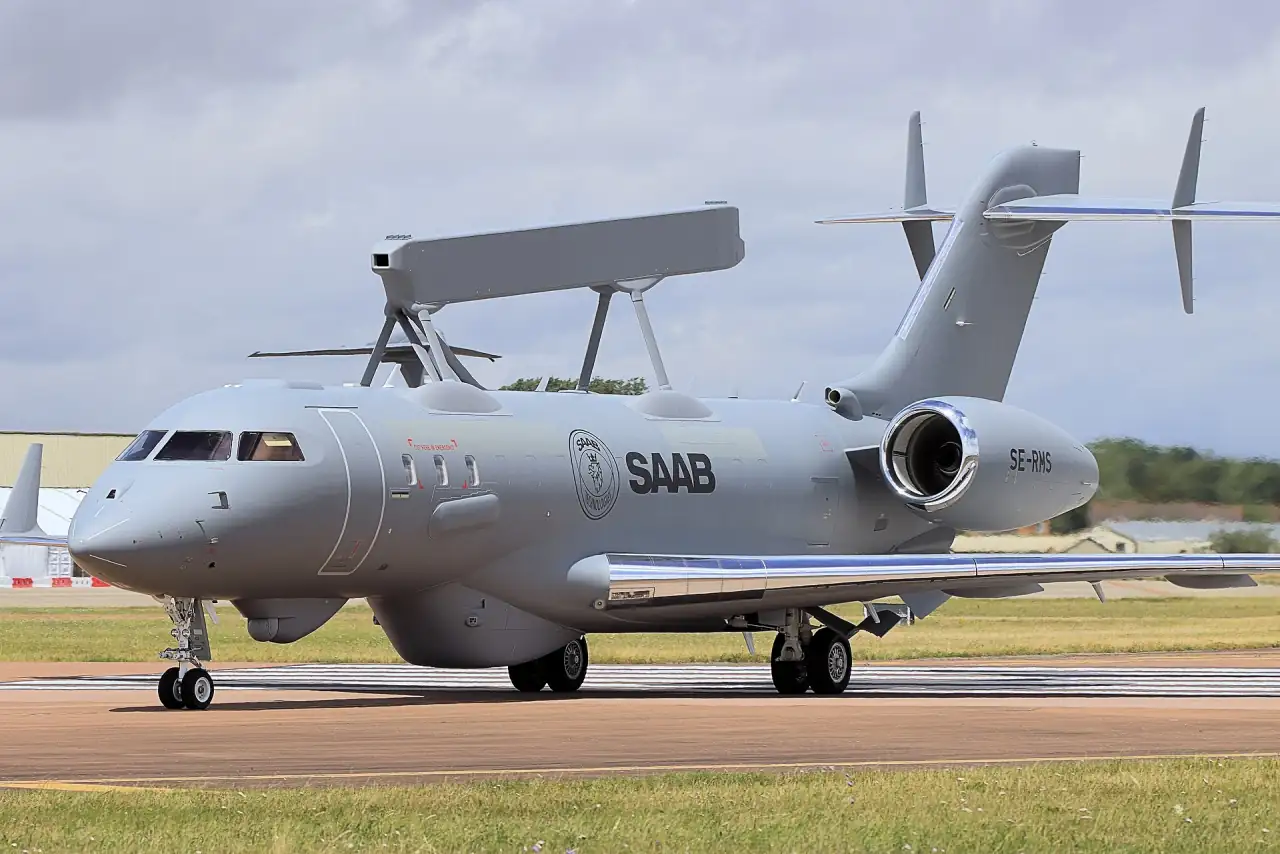
In a significant shift for alliance defense procurement, NATO’s Support and Procurement Agency (NSPA) has reportedly selected Sweden’s Saab and Canada’s Bombardier to supply the GlobalEye airborne early warning and control (AEW&C) platform as the replacement for the alliance’s aging fleet of 14 Boeing E-3A Sentry AWACS aircraft.
The decision, first reported by French defense publication La Lettre on April 23, 2026, and corroborated by German press agency dpa and other outlets, marks the end of a lengthy procurement process under the Alliance Future Surveillance and Control (AFSC) program. It also represents a historic break from nearly four decades of reliance on U.S.-built platforms for NATO’s shared airborne surveillance capability.
Background: From E-7 Ambitions to Collapse
NATO’s E-3 Sentry fleet, based primarily at Geilenkirchen Air Base in Germany, has served as the alliance’s “eyes in the sky” since the 1980s, providing long-range radar surveillance, command and control, and battle management. The aircraft, based on the Boeing 707 airframe, are approaching the end of their service life around 2035, with rising maintenance costs and declining availability prompting the search for a successor.
In November 2023, NATO initially selected the Boeing E-7A Wedgetail (a modified Boeing 737 platform already in service with Australia, Turkey, South Korea, and the UK) for the role, planning an initial buy of around six aircraft with potential for more. However, the program unraveled after the U.S. Air Force withdrew support in 2025, citing production delays, escalating costs (unit price rising toward $724 million), and concerns over survivability in contested environments. The Pentagon shifted focus toward space-based surveillance and additional E-2D Hawkeyes instead.
European partners, including the Netherlands, subsequently canceled the E-7 acquisition in November 2025, removing the “strategic and financial foundations” of the joint effort. This opened the door for alternatives, with Saab’s GlobalEye emerging as the frontrunner.
Why GlobalEye? A European-Canadian Solution
The GlobalEye integrates Saab’s advanced Erieye Extended Range (ER) active electronically scanned array (AESA) radar with the Bombardier Global 6000/6500 ultra-long-range business jet airframe. This combination delivers multi-domain surveillance, air, sea, and land with detection ranges exceeding 550 km (about 300 nautical miles), over 12–13 hours of endurance, and speeds up to 450 knots.
Key advantages cited include:
▪️Lower acquisition and operating costs compared to the E-7 (estimated unit cost around €550 million).
▪️A modern, off-the-shelf platform with excellent airfield performance, allowing operations from smaller bases.
▪️Advanced sensors, including electro-optical/infrared (EO/IR), maritime surveillance radar, electronic support measures (ESM/ELINT), and a full self-protection suite.
▪️Strong integration with NATO systems and multi-domain command-and-control capabilities.
The platform is already operational or ordered by the United Arab Emirates, Sweden (which joined NATO in 2024), and France (which selected it to replace its own E-3F fleet). Germany, Poland, and others have also shown interest.
Scale and Timeline
Reports indicate NATO could acquire 10–14 GlobalEye aircraft to fully replace the current E-3 fleet, with a total program value estimated at €5–6 billion (excluding training, infrastructure, and sustainment). Entry into service is targeted for the early 2030s, aligning with the need to phase out the aging Sentries by around 2035.
Production would involve Saab in Sweden for the mission systems and Bombardier in Canada for the airframes, promoting industrial participation across NATO members and allies. This setup contrasts with the more U.S.-centric E-7 approach and supports European efforts toward greater defense autonomy.
Strategic Suggestions
The move signals a broader trend: European NATO nations seeking resilient, cost-effective, and less dependent solutions amid shifting U.S. priorities and budgetary pressures. Saab CEO Micael Johansson has highlighted strong interest in the GlobalEye for NATO requirements, though the company has not officially confirmed a signed contract as of the latest reports.
A NATO spokesperson has neither confirmed nor denied the reports, and a final decision may be formalized at upcoming alliance meetings. If confirmed, this would be the first time since the late 1980s that a non-Boeing platform becomes the backbone of NATO’s shared AWACS force.
The GlobalEye selection underscores NATO’s adaptability, balancing operational needs with industrial and strategic considerations in an era of great-power competition and multi-domain warfare. For European defense industries, it represents a notable win; for Boeing, it is another setback in the AEW&C market following the U.S. program adjustments.
As details emerge, the alliance will need to address integration, training, and basing to ensure a seamless transition from the venerable E-3 Sentry to this sleek, high-performance Swedish-Canadian successor.