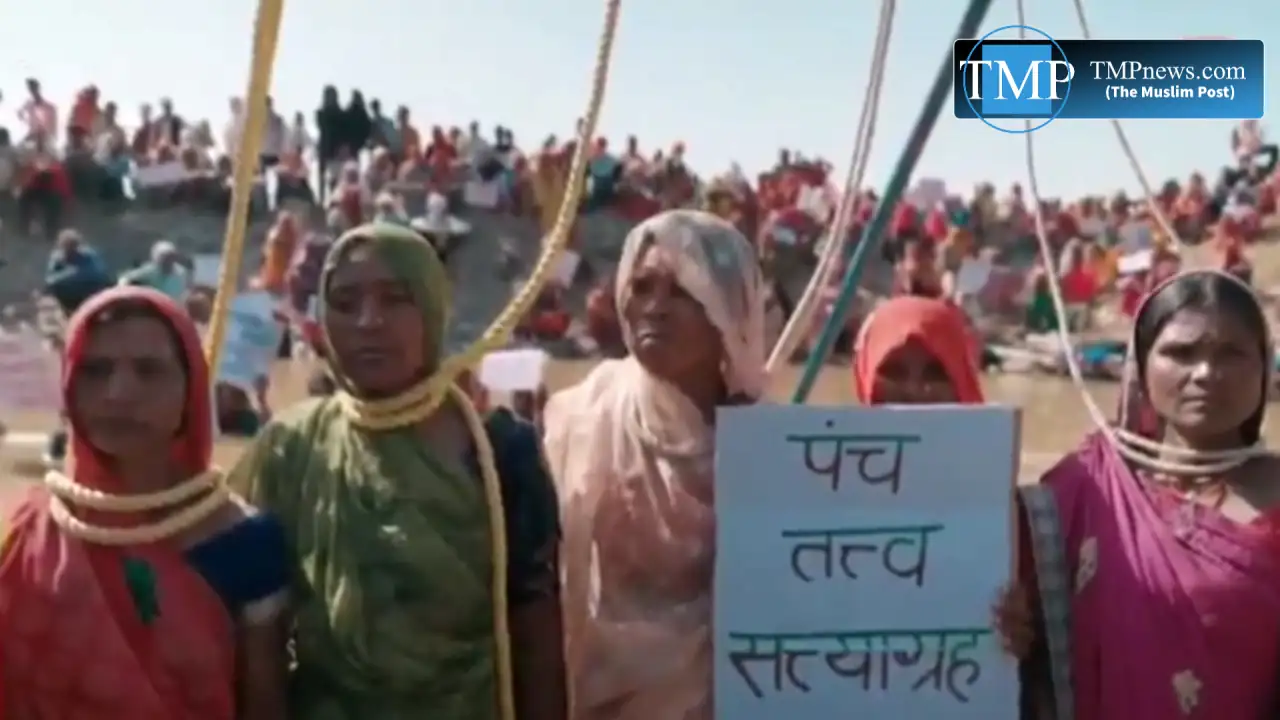
Hundreds of tribal families, mainly from Gond and Sahariya communities in Chhatarpur and Panna districts of Madhya Pradesh, have been protesting for over 11 days through the symbolic ‘Chita Andolan’ (Funeral Pyre Protest) or ‘Chitra Protest’. Protesters, including many women and children, have covered themselves in mud, lain on mock funeral pyres, undertaken hunger strikes, stood in waist-deep water as part of the ‘Panchtatva Andolan’, and simulated death to dramatize their fear that the submergence of their ancestral lands equates to cultural and livelihood death.
Their primary demands remain “land in return for land”, village-for-village rehabilitation, fair compensation as per the 2013 Land Acquisition Act, and full recognition of forest rights under the Forest Rights Act (FRA) and PESA. Many families claim they have lived on these lands and depended on the surrounding forests for generations, with some narratives tracing roots back centuries, making the displacement not merely economic but an existential threat to their identity and sustenance.
The Ken-Betwa Project and Immediate Conflict
The Ken-Betwa River Linking Project, a major national initiative, seeks to transfer water from the Ken River to the drought-prone Betwa basin to provide irrigation, drinking water, and hydropower benefits to parts of Madhya Pradesh and Uttar Pradesh. The Daudhan Dam component is set to submerge portions of around 24 villages, affecting thousands of families and parts of the Panna Tiger Reserve.
Tribals allege that construction and displacement processes have advanced with inadequate consultation, incomplete surveys, and violations of legal safeguards. Reports of homes being affected without proper alternatives, delayed or insufficient compensation, and a lack of transparent processes have fueled the agitation. Women at the forefront have declared it a “do or die” situation, emphasizing that monetary packages alone cannot replace their deep connection to the land and forests.
On April 16, 2026, a joint administrative team visited the site, leading to a temporary pause in the protest after assurances of a fresh survey and revised rehabilitation package. However, trust remains fragile.
A Pattern of Unfulfilled Promises: Historical Context Erodes Credibility
Skepticism toward government assurances stems from a long history of similar infrastructure projects in Madhya Pradesh where rehabilitation and compensation for displaced tribals have fallen short, often leaving communities in limbo for years or decades, even as projects themselves face delays or remain incomplete.
One prominent example is the Sardar Sarovar Dam under the Narmada Valley Development Project. Thousands of families, a majority of them tribals from Madhya Pradesh, were displaced, with estimates of affected people in the state running into tens of thousands. Decades later, many oustees continued to await full rehabilitation, with issues persisting regarding land allocation, site facilities, and additional compensation packages ordered by the Supreme Court. Reports highlighted “considerable slackness” in implementation by the state, leading to prolonged legal battles and protests by groups like the Narmada Bachao Andolan. Even as the dam reached higher levels, thousands of families in Madhya Pradesh reportedly remained without complete resettlement, underscoring gaps between policy promises and ground reality.
Similarly, the Indira Sagar and Omkareshwar dam projects on the Narmada displaced large numbers of people, including tribals in districts like Khandwa. Affected families reported forcible evictions, inadequate or non-existent agricultural land in rehabilitation sites, poor infrastructure (lack of roads, drinking water, and healthcare), and a sharp decline in living standards. People’s commissions and surveys documented cases where no cultivable land was provided as promised, leading to increased poverty and health issues among resettled communities. Protests and court interventions repeatedly highlighted failures in executing rehabilitation plans, with some measures remaining incomplete years after submergence.
The Bargi Dam (Rani Avanti Bai Sagar) on the Narmada, completed in the early 1990s, displaced over 5,000 families but lacked a comprehensive rehabilitation policy at the time. This resulted in years of agitation, with displaced people demanding fishing rights and better support. Delays in funding and implementation led to repeated cycles of protests, agreements, and non-fulfillment, leaving many in uncertainty long after the reservoir filled.
Such cases illustrate a recurring vulnerability in the administration’s approach to large projects: projects often get stalled or delayed due to protests, legal challenges, and implementation gaps, while displaced families suffer destroyed homes and lost livelihoods without receiving promised alternatives. Meanwhile, the intended beneficiaries, in this case, drought-affected farmers needing reliable water, continue to face scarcity because the infrastructure remains unfinished or underutilized.
This dual suffering creates a lose-lose situation. Displaced tribals endure immediate hardship and cultural disruption without adequate support, while broader developmental goals (like improved irrigation in Bundelkhand) remain unachieved. Government claims of robust rehabilitation packages for the Ken-Betwa project are thus viewed with suspicion by protesters, who point to these past events as evidence that assurances may not translate into timely, dignified outcomes on the ground.
Madhya Pradesh has a substantial tribal population that relies heavily on forest resources. Issues of land titles, FRA implementation, and meaningful community consent have surfaced repeatedly in development projects across central India. The ‘Chita Andolan’ has gained national attention through powerful visuals and social media, amplifying calls for senior-level intervention and adherence to legal frameworks.
Development projects inherently involve trade-offs, but sustainable progress requires balancing national priorities with the rights, consent, and long-term well-being of affected communities. Transparent surveys, land-for-land options where feasible, culturally sensitive rehabilitation, and accountable monitoring mechanisms are essential to rebuild trust.
As the situation evolves, continued dialogue between the administration, project authorities, tribal representatives, and civil society will be key. The protests serve as a reminder that ignoring historical lessons risks repeating cycles of displacement, delay, and discontent, ultimately harming both the most vulnerable and the larger goals of equitable water security and regional development. A just resolution must prioritize dignity and permanence over short-term expediency.