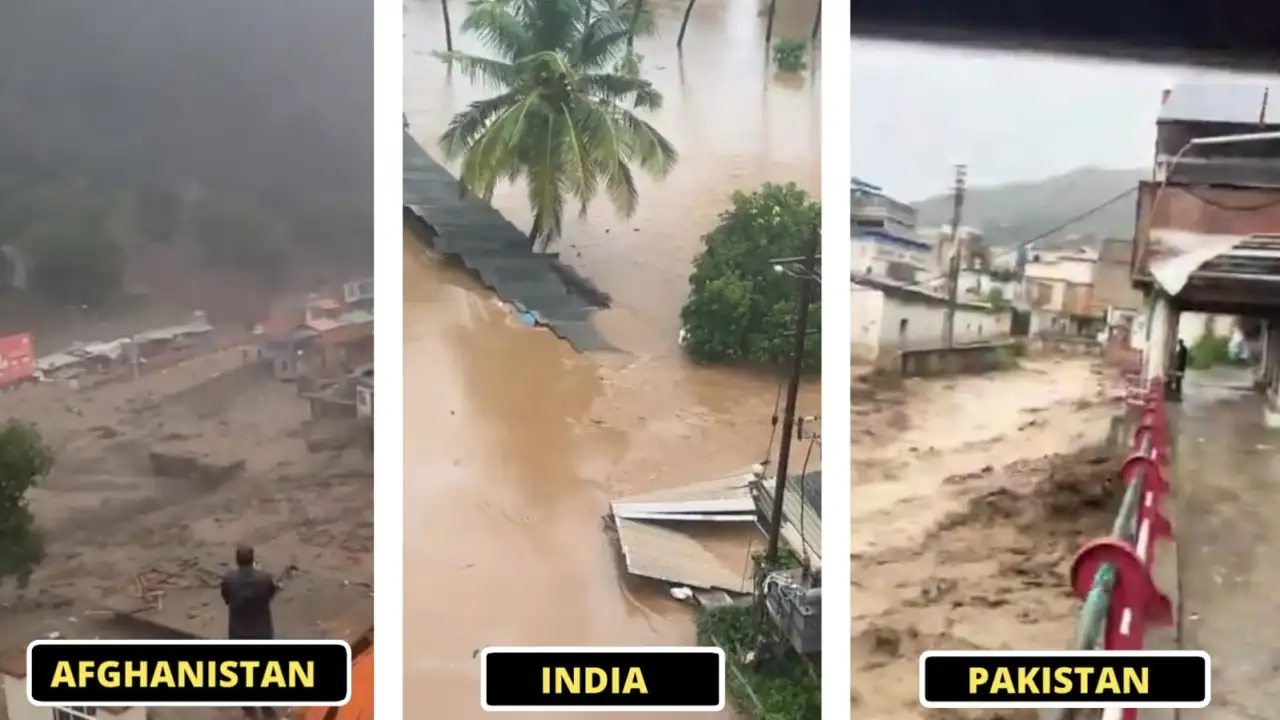
In a tragic convergence of extreme weather events, heavy monsoon rains and flash floods have claimed at least 82 lives across India, Pakistan, and Afghanistan in recent days, highlighting the region’s acute vulnerability to climate-driven disasters. The floods have displaced hundreds of thousands, destroyed homes, infrastructure, and livelihoods, and triggered urgent rescue and relief operations in some of the most rugged and densely populated terrains of South Asia.
While the immediate triggers differ slightly, intense upstream rainfall in India’s Northeast, flash floods in Afghanistan’s mountainous Nuristan province, and widespread inundation in Pakistan’s Khyber Pakhtunkhwa, the broader pattern points to intensifying monsoon variability exacerbated by climate change. Experts warn that countries like Afghanistan and Pakistan, which contribute minimally to global greenhouse gas emissions, are bearing a disproportionate burden of its consequences, including more frequent and severe floods, droughts, and glacial melt.
Assam's Unprecedented Deluge: Brahmaputra's Fury
In India’s northeastern state of Assam, at least 36 people have died in the ongoing floods, with 10 fatalities reported in the last 24 hours alone, according to state authorities. Over 650,000 people across 11 districts have been affected, with many more in surrounding areas impacted as the crisis unfolds. The Assam State Disaster Management Authority (ASDMA) described the situation as one of “unprecedented devastation.”
The floods were primarily triggered by exceptionally heavy rainfall in neighboring Nagaland between July 18 and 20, which caused massive inflows into the Brahmaputra River and its tributaries. Assam, home to the mighty Brahmaputra—one of the world’s largest rivers by discharge, experiences annual monsoon flooding, but this year’s events have been particularly severe due to cloudbursts and upstream deluges.
The Brahmaputra, originating in Tibet as the Yarlung Tsangpo and flowing through Arunachal Pradesh before entering Assam, carries enormous sediment loads. Deforestation in the catchment areas, combined with tectonic activity in the seismically active Himalayan region, has worsened erosion and siltation, reducing the river’s carrying capacity and leading to frequent breaches of embankments. Historical data reveals a grim pattern: major floods in 1954, 1962, 1972, 1977, 1984, 1988, 1998, 2002, 2004, 2012, and recurring annual inundations in recent years. The 1950 earthquake dramatically altered the river’s course and morphology, increasing flood proneness.
In the current wave, districts like Sivasagar, Jorhat, and Charaideo have seen villages submerged that rarely flooded in the past. Over 1,800 villages in 25 districts have been hit, with nearly 900,000 people affected in some reports. Relief camps house tens of thousands, and the Indian Army, Air Force, National Disaster Response Force (NDRF), and state teams are using boats, helicopters, and drones for rescues. Livestock losses are significant, and agricultural fields—vital for Assam’s rice and tea economy—lie underwater.
Long-term challenges include riverbank erosion displacing communities, loss of biodiversity in areas like Kaziranga National Park, a UNESCO World Heritage site home to the greater one-horned rhino and infrastructure damage to roads, bridges, and schools. Climate projections suggest that warming temperatures will intensify the Indian summer monsoon, leading to heavier downpours even as overall predictability decreases.
Statement by Assam Chief Minister Himanta Biswa Sarma:
“The current floods represent an unprecedented disaster for Assam, with destruction far greater than anticipated in several districts. We are mobilizing every resource—state, central, and international—for rescue and relief. A comprehensive ₹150 crore flood mitigation plan is underway in collaboration with IIT Guwahati. I urge all affected families to move to relief camps promptly. The central government, under Prime Minister Narendra Modi, has assured full support, and we are coordinating with neighboring states like Nagaland for better early warning systems. Our focus is not only on immediate recovery but on building long-term resilience against these recurring calamities.”
Afghanistan and Pakistan: Flash Floods in Rugged Terrains
In Afghanistan’s northeastern Nuristan province, at least 20-23 people have been killed, with over 80 injured and more than 100 missing following flash floods that swept through Parun (the provincial capital) and surrounding villages. The floods destroyed homes, hotels, shops, markets, roads, and bridges in a region already grappling with poverty and limited infrastructure. Taliban authorities described “complete devastation,” with rescue operations involving heavy machinery to reach trapped individuals.
Nuristan’s steep valleys and fragile ecology make it highly susceptible to flash floods. Heavy rainfall on July 20 triggered landslides and mudflows, compounding the damage. The Taliban-run National Disaster Management Authority (NDMA) has mobilized teams, and international aid, including from India (tents and food supplies), is arriving.
In Pakistan’s Khyber Pakhtunkhwa province, floods have contributed to the regional toll, with combined deaths across Afghanistan and Pakistan reaching around 46 in the last 72 hours. KP, bordering Afghanistan, frequently faces monsoon-triggered floods and landslides due to its mountainous terrain and the Indus River system’s tributaries. Infrastructure damage includes roads washed away and agricultural losses in a province vital for Pakistan’s food security.
Both countries face heightened climate risks: rapid glacial melt in the Hindu Kush-Himalaya region increases glacial lake outburst flood (GLOF) threats, while erratic rainfall patterns disrupt traditional water management. Afghanistan, one of the most vulnerable nations, has seen multiple deadly floods in recent years, with limited adaptive capacity due to ongoing humanitarian challenges.
Statement by a Senior Official from Pakistan’s Khyber Pakhtunkhwa Disaster Management Authority (Representative Statement):
“The floods in Khyber Pakhtunkhwa have caused significant loss of life and property, affecting thousands of families. We are working round the clock with the Pakistan Army and federal authorities to provide relief, including food, medical aid, and temporary shelters. Prime Minister Shehbaz Sharif has directed immediate assistance. This tragedy underscores the need for enhanced regional cooperation on climate resilience, early warning systems, and infrastructure development to protect our vulnerable mountainous communities.”
Statement by Taliban National Disaster Management Authority Spokesperson (Representative Statement, based on reports):
“The flash floods in Nuristan have brought immense suffering, with many homes and livelihoods destroyed. Our rescue teams are working tirelessly to recover the missing and assist the injured. We call on the international community and neighboring countries for urgent humanitarian support. Afghanistan remains committed to protecting its people despite limited resources, and we emphasize the global responsibility to address climate change impacts on vulnerable nations like ours.”
Voices from the Ground: Human Cost of the Calamity
Quote from Affected Resident (Mujib ur Rahman, Nuristan):
“The floods swept away houses and hotels. Everything is gone. It is complete devastation. Machinery is being used to rescue those who are still trapped.”
Similar stories echo across Assam, where families have lost loved ones, homes, and livestock. In Pakistan’s KP, residents recount nights of terror as rivers swelled beyond recognition.
South Asia’s monsoon system is complex, influenced by the Indian Ocean Dipole, El Niño/La Niña, and Himalayan orography. Climate change is amplifying extremes: warmer air holds more moisture, leading to intense precipitation events. Studies show increasing flood frequency and magnitude in the Brahmaputra basin.
In Afghanistan and Pakistan, post-conflict recovery and economic constraints limit adaptation. Deforestation, unplanned urbanization, and inadequate drainage exacerbate risks. The Hindu Kush Himalaya (HKH) region, often called the “Third Pole,” is warming faster than the global average, threatening water security for billions downstream.
Economic impacts are staggering. In Assam alone, annual flood damages run into thousands of crores of rupees, affecting GDP, agriculture (which employs a large population), and education (schools submerged for months). Health risks include waterborne diseases in camps. Biodiversity loss threatens species like the Gangetic dolphin and rhinos.
Response and Relief Efforts
Governments are responding with coordinated efforts:
India: Central teams assessing damage; NDRF, armed forces deployed; compensation packages announced; focus on embankment repairs and dredging.
Pakistan: Army-led rescues; federal relief funds; calls for international aid.
Afghanistan: Taliban-coordinated operations; appeals for global support; aid from neighbors like India.
International organizations like the UN, Red Cross, and IFRC are monitoring and providing assistance. Long-term solutions proposed include better forecasting, afforestation, sustainable land use, community-based early warning systems, and regional river basin management involving China, India, Bangladesh, etc.
Historical Parallels and Lessons
Assam’s flood history dates back centuries, but post-1950 changes intensified the problem. The 1988 floods affected millions; 2012 saw massive displacement. Each event offers lessons: investing in “living with floods” approaches like raised houses, wetland preservation, and agro-flood adaptive farming rather than solely engineering solutions that often fail.
In Pakistan, the 2022 super-floods killed over 1,700 and displaced millions, costing billions. Afghanistan has faced repeated tragedies, underscoring systemic vulnerabilities.
To mitigate future disasters, priorities include:
-
Early Warning Systems: Upgrading meteorological infrastructure and cross-border data sharing.
-
Infrastructure: Climate-resilient embankments, bridges, and drainage.
-
Ecosystem Restoration: Reforestation in catchments to reduce runoff and erosion.
-
Community Preparedness: Training, insurance, and diversified livelihoods.
-
Global Climate Action: Support for adaptation funds, technology transfer, and emission reductions by high emitters.
-
Research and Policy: Integrated basin management and urban planning that accounts for flood zones.
The current tragedy, while devastating, offers a moment for reflection and unified action. As one official noted, these events are not isolated but symptoms of a changing climate that demands collective response.