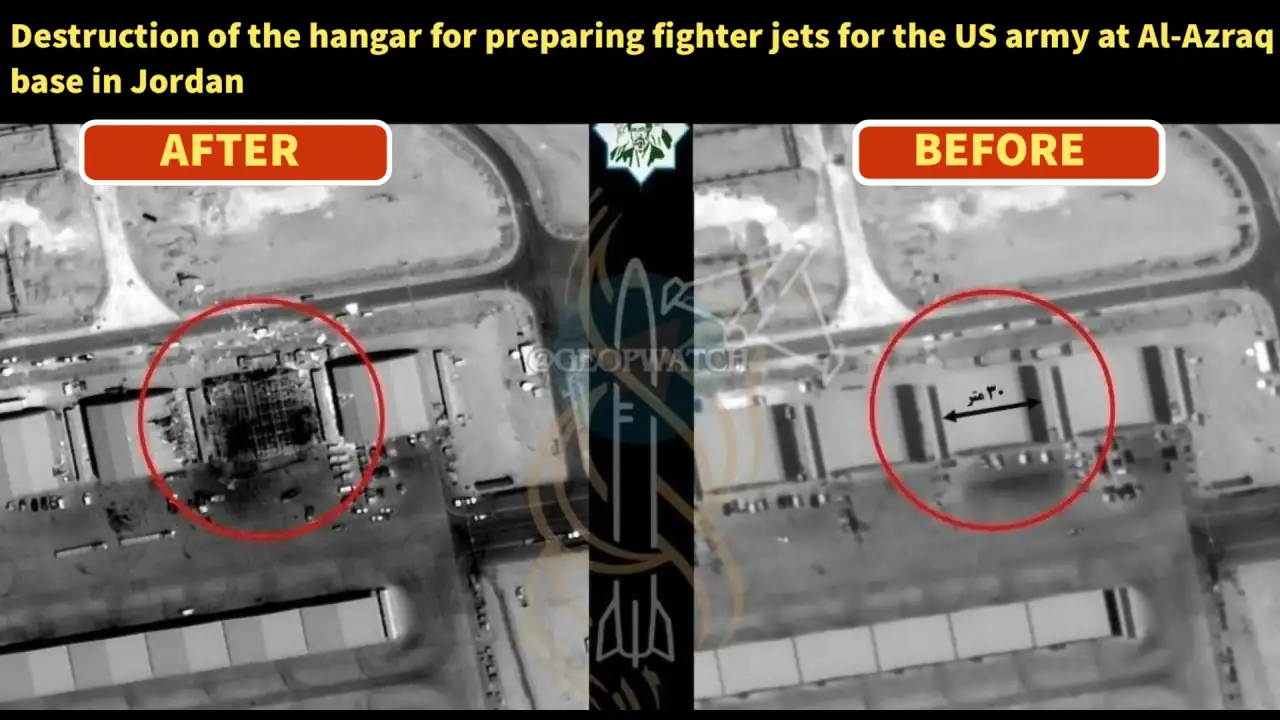
In a significant escalation of regional tensions, the Islamic Revolutionary Guard Corps (IRGC) of Iran claimed responsibility for a ballistic missile strike on the Muwaffaq Salti Air Base (also known as Al-Azraq Air Base) in Jordan. The attack reportedly targeted facilities used by US forces, including hangars housing or preparing advanced fighter jets such as the F-35 Lightning II.
Muwaffaq Salti Air Base, located in Jordan’s Zarqa Governorate near Azraq (approximately 100 km east of Amman), serves as a key Royal Jordanian Air Force installation. It has hosted US and NATO operations, including support for missions against ISIS. In early 2026, satellite imagery showed a major US buildup at the base, with dozens of F-35 and F-15 fighter jets, cargo planes, drones, and helicopters deployed there amid heightened concerns over potential conflicts with Iran.
The base features hardened aircraft shelters and hangars designed to protect high-value assets like stealth fighters. US forces have used it as a forward hub for regional air operations.
On or around June 10, 2026 (with some reports referencing follow-on or related actions in July), the IRGC announced that its Aerospace Force launched long-range solid-fuel ballistic missiles, reports vary between 10–12 missiles at the base. Iranian state media, including Tasnim, Mehr, and IRNA, stated that the strikes hit four key targets, specifically including:
▪️Hangars sheltering or preparing F-35 fighter jets for US operations.
▪️The base’s command-and-control center.
The IRGC described the operation as a “retaliatory” or “punitive” response to US aggression against Iranian territory, including strikes near cities like Karaj, Nazarabad, and Pishva, as well as earlier naval and drone actions in the region. Iranian statements emphasized the use of precision missiles and warned of further decisive responses if provoked.
Iranian sources claimed successful destruction of the targeted hangars and a “large number” of US fighter aircraft (F-35, F-15, and F-16 variants). Subsequent open-source intelligence (OSINT) and satellite imagery analyses from providers like Sentinel-2 reportedly showed signs of damage, including scorch marks, structural anomalies, blast signatures near hardened hangars, and impacts on the apron and flight-line areas. Some reports specifically noted hits on two recently activated hangars.
Jordanian authorities stated that air defenses intercepted many incoming missiles e.g claims of 8–20 intercepted, with falling debris causing no initial casualties or major damage in some accounts. However, later reports and imagery suggested that at least some projectiles reached the base, causing visible destruction to infrastructure. US officials have been cautious in public statements, with CENTCOM confirming defensive actions and, in related updates, noting personnel impacts in subsequent incidents.
No comprehensive, independently verified casualty figures or full damage assessments for US aircraft have been publicly released by American or Jordanian authorities as of the latest reports, though the presence of advanced fighters at the base made the hangars high-priority targets.
This incident fits into a pattern of escalating direct exchanges between Iran and US/Israeli-aligned forces in 2026, involving missile and drone barrages across multiple countries. It underscores the strategic importance of forward bases like Al-Azraq for US power projection in the Middle East and the growing reach of Iranian ballistic missile capabilities.
The attack has raised concerns about the vulnerability of even well-defended air bases to saturation strikes and the risks of wider regional war. Jordan, which maintains strong ties with the US while navigating complex alliances, has reiterated its commitment to defending its airspace.
As the situation develops, further satellite analysis, official briefings, and potential retaliatory actions will likely clarify the full extent of the damage to the fighter jet preparation hangars and overall base operations.