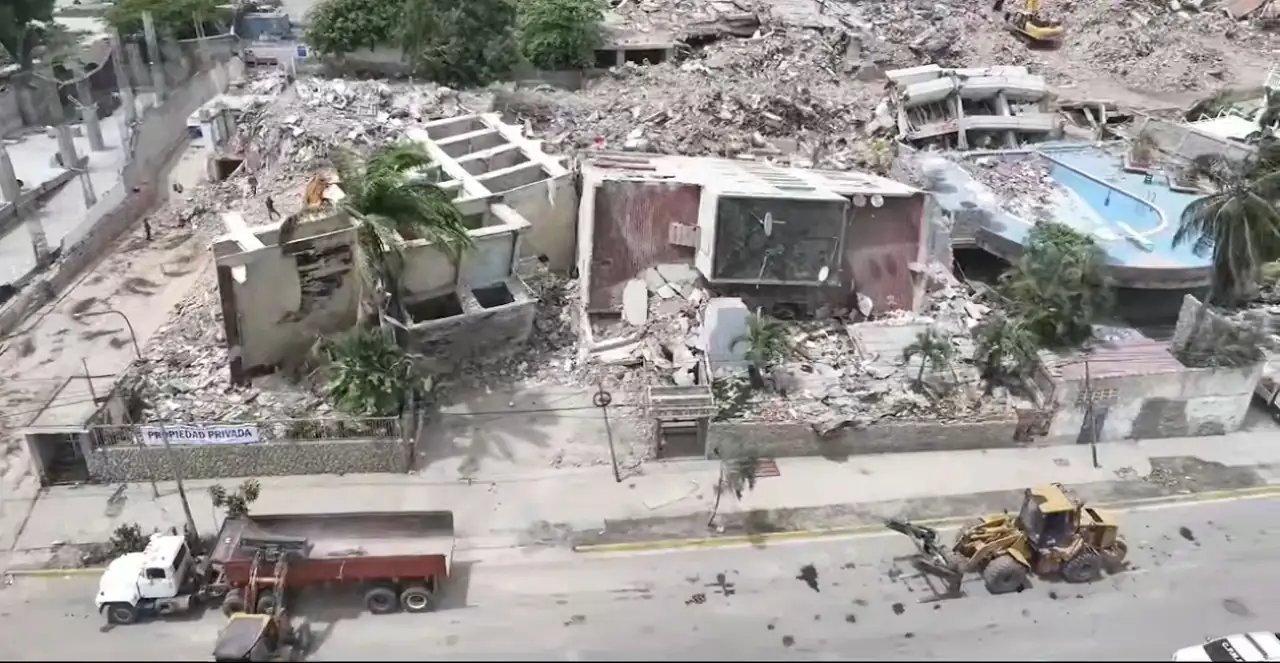
Two powerful earthquakes that struck northern Venezuela on June 24, 2026, caused an estimated $19.6 billion in direct physical damage, according to a Global Rapid Damage Estimation (GRADE) released by the World Bank Group. The twin quakes magnitudes 7.2 and 7.5, centered near Morón in Carabobo state rank among the deadliest natural disasters in the country’s modern history, the most lethal since 1812.
The disaster killed more than 5,000 people, government figures have cited around 5,398 and injured roughly 16,700–17,000 others. Tens of thousands were displaced, with many left homeless or living in temporary camps, particularly in the hardest-hit areas of La Guaira state and the Capital District (Distrito Capital), which together accounted for about half of the total damage.
According to the World Bank assessment, residential buildings bore the brunt of the destruction, representing 47% of the total damage. Infrastructure accounted for 27%, and non-residential buildings 26%. The report notes that the earthquakes severely disrupted critical services; education and health facilities were among those affected across multiple states, compounding challenges in a country already facing high poverty and the lingering effects of mass emigration.
The GRADE estimate covers direct physical damage to buildings and infrastructure only. It does not include broader economic losses, debris clearance, or the higher costs of “building back better.” World Bank officials have indicated that full reconstruction and upgrades could push the overall bill toward $40–50 billion. Under current investment levels, recovery could stretch beyond a decade with lasting drags on growth and living standards; faster, better-funded reconstruction would significantly reduce those long-term impacts.
World Bank Statement
“The earthquakes have disrupted lives, damaged critical infrastructure, and created new challenges for Venezuela’s recovery. Recovering effectively begins with reliable evidence. This assessment gives the Government of Venezuela and its partners an early objective foundation for recovery planning, and the World Bank Group is committed to supporting that effort every step of the way.”
— Susana Cordeiro Guerra, World Bank Vice President for Latin America and the Caribbean
In related remarks, Cordeiro Guerra described the $19.6 billion figure as a staggering figure for any economy and one that demands a coordinated response, warning that without timely additional investment, “the negative impact on productive capacity and living standards will slow the path to recovery.”
The World Bank is coordinating with the Government of Venezuela, the Inter-American Development Bank, and the Development Bank of Latin America (CAF) on further needs assessments and potential technical and financial support.
Government Response
Acting President Delcy Rodríguez declared a national state of emergency shortly after the quakes, designated affected zones as disaster areas, and mobilized civil and military rescue personnel. Authorities reported deploying thousands of responders in the initial days, later expanding operations with international field hospitals and support.
Government Statements
“We did not wait one day, two days or three days. We activated immediately.”
— Acting President Delcy Rodríguez, defending the speed of the official response amid public criticism of early rescue efforts.
“That is the instruction to the national government: deploy and work tirelessly, save lives, and care for the survivors as we are doing and will continue to do. Despite the challenges, we have received both national and international support.”
— Acting President Delcy Rodríguez, addressing concerns over the pace and scale of relief operations.
Rodríguez’s interim administration has also discussed reconstruction financing options, including potential use of frozen Venezuelan assets held abroad, while international humanitarian groups such as the Red Cross and World Food Programme have delivered aid to more than 100,000 affected people. The U.S. has provided hundreds of millions in assistance.
The World Bank’s rapid assessment provides an early benchmark for prioritization as Venezuela confronts one of its most severe disasters in recent history. Full recovery will depend on the speed and scale of investment in housing, infrastructure, and public services in the hardest-hit northern regions.